Scandola in Corsica: What This Reserve Reveals Before You Go by Boat
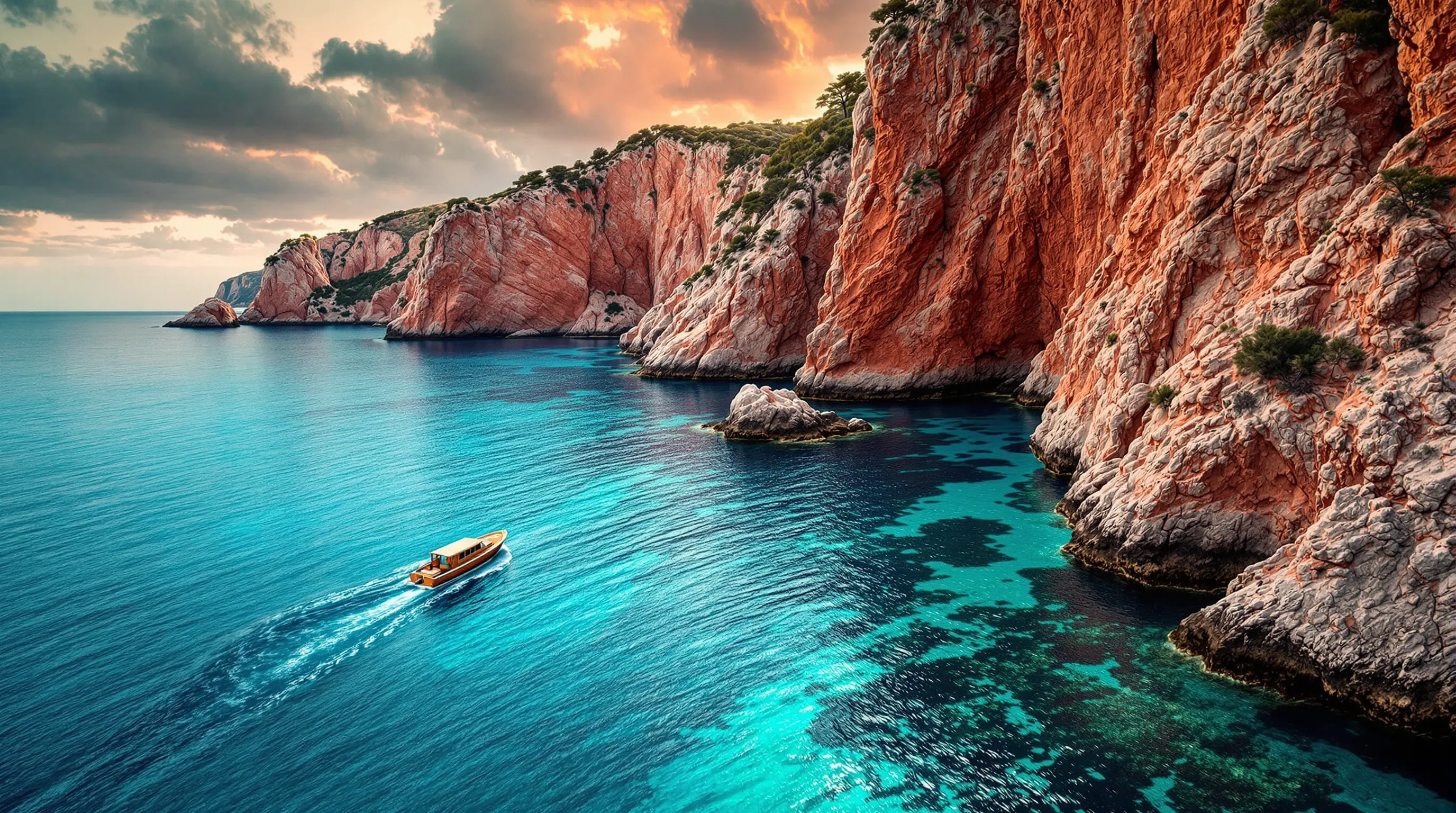
The first time I skirted the red porphyry cliffs of Scandola aboard a rigid inflatable out of Porto, I cut the engine in the middle of the gulf just to listen. Total silence, save for the cry of shags nesting in the rock. Designated a nature reserve since 1975 and inscribed as a UNESCO World Heritage Site alongside the Calanques de Piana, Scandola isn't a place you visit like an ordinary beach: there's no way in on foot, no path crosses its heart, and that's precisely what makes it a preserved sanctuary where ospreys, groupers and bottlenose dolphins still thrive.
A unique marine and terrestrial sanctuary in the Mediterranean
Scandola covers roughly 1,000 hectares of land and a similar area of protected marine zone, between Girolata and the Gulf of Porto, within the commune of Osani. The red porphyry and rhyolite cliffs, carved by volcanic erosion over 250 million years ago, plunge straight into remarkably clear water. It's one of the few places left in the Mediterranean where ospreys still nest naturally, with a handful of breeding pairs monitored each year by the Corsican Environment Office. Beneath the surface, Posidonia seagrass meadows shelter dusky groupers, brown meagre and spiny lobsters, protected species that have benefited hugely from the total ban on fishing and anchoring at the heart of the reserve. Bottlenose dolphins regularly patrol the waters offshore, drawn by the gulf's abundant fish stocks.
Why there's no land access allowed
The reserve has no public walking trails within its boundaries: this is a deliberate choice to limit human pressure on osprey nests and fragile coastal vegetation. Only the sea route allows for observation, run by licensed professional operators. Far from being a limitation, this rule is what has kept the ecosystem intact, one that mass tourism would have degraded elsewhere within a decade.
Where to set sail: Porto, Girolata and Calvi as gateways
Three main departure points give you access to Scandola by boat. Porto, tucked at the end of its spectacular gulf, remains the shortest route, roughly 45 minutes' sailing to reach the heart of the reserve. Girolata, a hamlet reachable only on foot or by boat from the Col de la Croix or Porto, offers a picturesque mooring right on the southern edge of the protected zone. Calvi, further north, offers full-day excursions that include Scandola and often the Calanques de Piana on the way back. Local operators run passenger launches or faster RIBs, each offering a different way of approaching coves such as Focolara or Ficaghjola. No landing is permitted on the protected islets or in most of the coves at the reserve's core; only slow, idle-speed navigation is tolerated there.
Girolata, the hamlet with no road
Girolata is worth lingering in before or after your boat trip: this fishing hamlet, overlooked by a 16th-century Genoese tower, can only be reached via a two-hour coastal path from the Col de la Croix, or by boat. Many visitors stop here for lunch before heading on to Scandola, which helps break up the day and avoid the midday rush of launches.
When to go: dodging the crowds and catching a calm sea
The excursion season generally runs from April to October, with a peak in July and August when boats crowd the most photogenic coves. June and September strike the best balance: the sea is still warm, the late-afternoon light on the red cliffs is gorgeous, and there are noticeably fewer visitors, allowing for a calmer approach to the wildlife. The mistral and westerly winds can make for uncomfortable sailing, or even cancelled trips, particularly in spring; it's worth building a day or two of flexibility into your holiday to work around the weather rather than booking your only available slot. Early departures before 9am generally mean a flatter sea and better underwater visibility for spotting groupers and shoals of fish from a glass-bottom boat, where that option is available.
Planning your trip: duration, fitness level and useful kit
A typical excursion to Scandola lasts between three and six hours, depending on the departure point and whether it includes the Calanques de Piana or Girolata. No particular fitness level is needed since most of the experience happens on board, but do factor in the possibility of seasickness on what can be a long stretch of open water if the wind picks up. Bring a hat, water-resistant sun cream, a light windbreaker even in summer since the open sea cools quickly, and binoculars for watching ospreys nesting up on the cliffs without disturbing them. Cameras with a telephoto lens let you capture wildlife without needing to get too close. It's strongly advisable to book several days ahead in peak season, as spaces on licensed launches are limited by navigation quotas imposed within the reserve to preserve the site's tranquillity.
Choosing between a shared launch and a private RIB
The shared launch remains the more affordable and sociable option, with a guide narrating the trip, but it ties you to the group's schedule. A small-group RIB, often capped at fewer than ten passengers, offers scheduling flexibility and access to quieter coves, at a higher price. The choice mainly comes down to how much time you have and your budget for the excursion.
Practical tips and responsible tourism
The cost of a Scandola excursion varies considerably depending on duration, type of boat and season: a shared trip in peak season costs more than an early booking in June or September, and full-day packages with a stop at Girolata are naturally pricier than a simple round trip from Porto. Always book with operators displaying the official licence to navigate within the reserve, a minimal guarantee that the rules are being respected. If dolphins or whales are spotted offshore, ACCOBAMS regulations require a minimum distance, a side-on approach that never cuts across the animals' path, and cutting the engine if a group approaches the boat of its own accord. Favour operators certified as High Quality Whale Watching, committed to a low-impact observation charter. Don't throw anything overboard, avoid non-biodegradable sun cream near the Posidonia meadows, and keep quiet as you approach the cliffs where ospreys nest.
Frequently asked questions
Can you visit Scandola on foot or by hiking?
No, there's no official trail through the heart of the nature reserve. Access is exclusively by boat from Porto, Girolata or Calvi. This restriction protects osprey nests and fragile coastal vegetation. Only Girolata, on the southern edge, remains reachable on foot via a coastal path.
What's the best time to see Scandola without the crowds?
June and September offer the best balance of favourable weather, warm sea and lower visitor numbers compared with July and August. Morning departures before 9am tend to mean calmer seas and better visibility for spotting marine wildlife from the boat.
Can you swim or dive in the Scandola reserve?
Swimming is permitted in certain areas, but anchoring and free diving are strictly regulated, or banned outright, at the heart of the reserve. Check with your operator, as rules vary by zone and are regularly updated to protect the Posidonia seagrass meadows.
Do you actually see dolphins near Scandola?
Bottlenose dolphins regularly frequent the waters of the Gulf of Porto and off Scandola, drawn by the abundance of fish. Sightings are never guaranteed since these are wild animals, but experienced guides know the areas where encounters are most likely depending on the season.
How much time should I set aside for a full Scandola excursion?
Allow between three and six hours depending on your departure point and whether the trip includes Girolata or the Calanques de Piana. From Porto, the one-way journey takes around 45 minutes; set aside a full day if you're departing from Calvi, which is further away.
Scandola isn't a destination you simply tick off a list, it's an encounter with a stretch of coastline that has stayed wild thanks to decades of strict protection. Between porphyry cliffs, ospreys and bottlenose dolphins offshore, every trip out to sea reveals a fragment of preserved Mediterranean. Choose a licensed operator, favour June or September, and respect wildlife viewing distances. To help plan your excursion and learn more about the cetaceans you might encounter along the way, check out our detailed guides at dauphin-mediterranee.com.
Read also

Cap d'Antibes: The Secret Path Where Sea and Pines Offer an Unforgettable Swim
Discover the coastal path at Cap d'Antibes: wild coves, turquoise swimming spots...

Collioure: The Secret Coves Local Divers Keep to Themselves
Discover the best coves in Collioure and the Vermeille Coast for swimming and sn...

La Ciotat: what lies beneath the turquoise surface at Bec de l'Aigle
Discover La Ciotat differently: hidden calanques, wreck diving and Bec de l'Aigl...

Cap d'Antibes: What the Coastal Path Reveals to Attentive Walkers
Discover the Cap d'Antibes coastal path: hidden coves, wild swimming and Mediter...