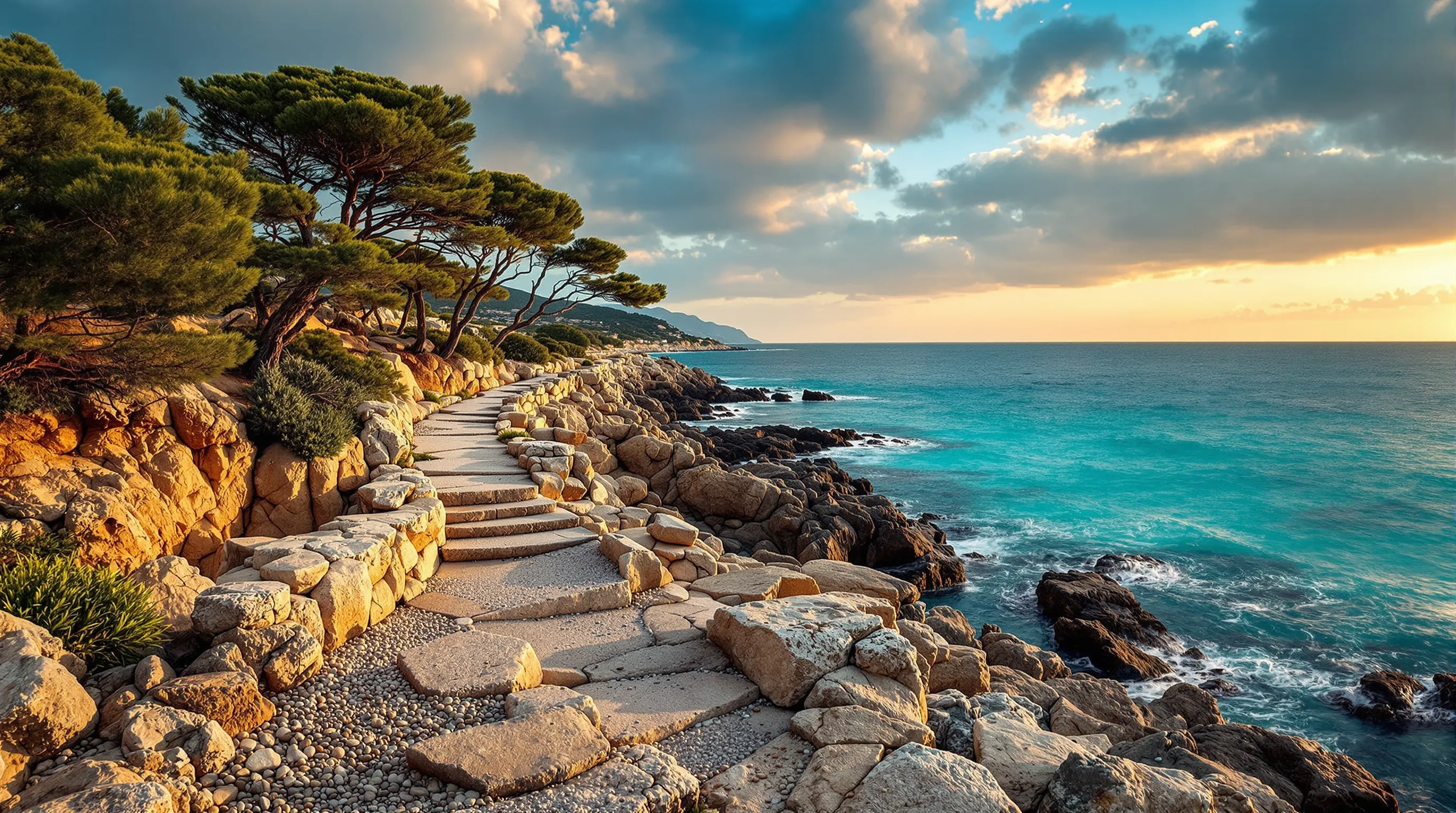
Cap d'Antibes: The Secret Path Where Sea and Pines Offer an Unforgettable Swim
The first time I walked the Tirepoil path, early one morning, the smell of warm pine resin was already mingling with the sea spray. This trail, which wraps around Cap d'Antibes for nearly five kilometres, offers one of the finest face-to-face encounters with the Mediterranean anywhere on the Côte d'Azur. Between secluded coves, rocks smoothed by the waves and centuries-old umbrella pines, it's easy to see why local fishermen once called this stretch of coast 'the lovers' promenade of the sea'. Here's how to make the most of it, while respecting this fragile gem.
A coastal path shaped by history and geology
The coastal path of Cap d'Antibes, also known as the Tirepoil path, follows the headland separating the Golfe de la Garoupe from the Bay of Billionaires. Listed among the protected routes managed by the Conservatoire du littoral, it winds between the private grounds of Villa Eilenroc and the public coves of La Garoupe, with the Île Sainte-Marguerite as a backdrop. The reddish rocks, formed from conglomerate stone, contrast beautifully with the deep blue sea, creating landscapes that feel almost Cornish in their wildness, yet distinctly Mediterranean in their vegetation. Aleppo pines, myrtle and mastic trees scent the air, while the waves have shaped these low cliffs for centuries, all easily accessible on foot. Historically, this path was used by customs officers and Antibes fishermen to keep watch over the coastline; today it draws walkers and swimmers seeking authenticity, far from the crowded beaches of the town centre.
Villa Eilenroc and its listed park
Along the way, you'll pass the grounds of Villa Eilenroc, a historic property designed by architect Charles Garnier in the 19th century. The park, open to the public on certain days depending on the season, is home to rare Mediterranean species and a remarkable rose garden. This landscaped heritage site, maintained by the town of Antibes, illustrates the balance between residential development and the preservation of the natural coastline, a key issue on this highly sought-after peninsula.
Where exactly to walk and swim on the Cap
The most convenient starting point is the car park at Plage de la Garoupe in Antibes, accessible via Boulevard de la Garoupe. From there, the path heads west towards Pointe Bacon, offering a first opportunity to swim in a quiet rocky cove. Continuing towards the Garoupe lighthouse and semaphore station, you'll reach wilder swimming spots, such as the Argent Faux cove, where turquoise water contrasts with ochre rocks. Further along, Pointe de l'Ilette and Plage de la Salis, on the eastern side, complete the route for walkers wishing to loop back round to Port Vauban. Note: certain sections, particularly near La Garoupe, are temporarily closed during strong mistral winds or rockfall risk – check with the town hall or the Antibes Juan-les-Pins tourist office website for current information.
Argent Faux cove, a favourite swimming spot
Less well known than Plage de la Garoupe, this cove takes its name from the silvery glint of the water at certain times of day. Access is via a stony path requiring sturdy, closed-toe footwear. Swimming here is excellent when the sea is calm, with clear water allowing you to spot sea urchins and small rockfish. There are no lifeguards or facilities, so caution is advised, especially with children.
The best season for walking and swimming without the crowds
June and September remain the most favourable months: the sea reaches pleasant temperatures (around 22 to 24°C) without the density of visitors seen in July and August. The mistral and easterly winds, common in spring, can make swimming dangerous in exposed areas such as Pointe Bacon; it's worth checking the local marine forecast before setting off. In winter, the path is mainly used for walking, with beautiful low-angle light in the late afternoon, though swimming becomes an option only for the hardiest. Spring, particularly April and May, brings the vegetation into bloom with still-moderate visitor numbers, ideal for photography and observing Mediterranean flora. July and August, despite the sea reaching its warmest (25-27°C), see the path packed from 9am onwards, with parking around La Garoupe near impossible; it's best to set off very early or after 6pm.
Planning your outing: duration, difficulty and essential kit
Walking the full loop of Cap d'Antibes takes around 2.5 to 3 hours at a leisurely pace, not including swimming stops. The route is manageable for anyone in reasonably good shape, but the uneven terrain, sometimes slippery near the rocks, rules out flip-flops in favour of lightweight walking shoes or sturdy sports sandals. Bring plenty of water (there are no refill points along most of the route), a cap and water-resistant sun cream, as shade is scarce along several south-facing stretches. A lightweight snorkelling mask lets you make the most of the coves to observe marine life, which is particularly rich around the rocks at Pointe Bacon. For families, it's better to break the walk into shorter there-and-back stretches from La Garoupe rather than attempting the full loop, especially with young children.
Access and parking around the Cap
The car park at Plage de la Garoupe, chargeable during the season, remains the most central option. Summer shuttle buses and cycle paths also connect central Antibes to the Cap, a welcome alternative in July and August when parking fills up. The local bus service also stops near the path, a handy way to cut down on car use on this already busy peninsula during peak season.
Practical tips and responsible tourism
A trip to Cap d'Antibes remains budget-friendly: access to the path is free, with only seasonal parking or optional snorkelling gear hire representing a variable cost depending on timing and duration. Booking isn't necessary for the walk itself, but checking Villa Eilenroc's opening hours beforehand saves any disappointment. This coastline, though popular, is home to sensitive marine biodiversity: seagrass meadows, sea urchins and small rockfish deserve simple courtesies, such as taking nothing away and avoiding walking on seagrass beds while snorkelling. If you spot dolphins offshore – rare but not impossible from the headland – remember the ACCOBAMS guidelines: keep a distance of at least 100 metres, never encircle the animal, and switch off a boat's engine if nearby. Choosing sea excursions with the High Quality Whale Watching label guarantees respectful observation, should you fancy a complementary boat trip off Antibes or the Baie des Anges. Finally, always take your rubbish home with you: there are no bins along most of the path.
Frequently asked questions
Is the Cap d'Antibes coastal path suitable for children?
Yes, on the shorter stretches from Plage de la Garoupe, with constant supervision near the rocks. The full 2.5-hour loop is too long for young children; opt instead for a there-and-back walk of no more than an hour, with closed-toe shoes to avoid slipping on the rocky sections.
Can you swim anywhere along the path?
No, some coves such as Pointe Bacon are only accessible when the sea is calm and have no lifeguard supervision. Always check sea conditions before heading down, avoid areas with heavy swell, and stick to sheltered coves like Argent Faux for safer swimming.
What's the best time to avoid the crowds at Cap d'Antibes?
June and September offer the best balance between pleasant weather and moderate visitor numbers. July and August see peak crowds from early morning onwards, while spring and autumn allow you to enjoy the path in relative solitude, with water that's cooler but still swimmable.
Do you need any special kit to walk this path?
Lightweight walking shoes or sturdy sandals are recommended due to the rocky, occasionally slippery terrain. Also bring water, a cap, sun cream and possibly a snorkelling mask to explore the coves along the way.
Can you spot dolphins from Cap d'Antibes?
It's possible but rare from the shore, as dolphins tend to stay further out to sea. For a reliable and respectful sighting, choose a boat trip with an operator holding the High Quality Whale Watching label, which guarantees ACCOBAMS distance rules are followed and cetaceans are protected.
The Cap d'Antibes coastal path brings together, in a single route, wild walking trails, hidden swimming spots and an exceptional landscape heritage. Whether you're after a quiet cove for a swim or a sunset stroll among pines and rocks, this site deserves to be discovered with care, away from peak hours. To extend the experience out at sea and observe Mediterranean marine wildlife the right way, find our guides and responsible boat trips at dauphin-mediterranee.com.
Read also

Collioure: The Secret Coves Local Divers Keep to Themselves
Discover the best coves in Collioure and the Vermeille Coast for swimming and sn...

La Ciotat: what lies beneath the turquoise surface at Bec de l'Aigle
Discover La Ciotat differently: hidden calanques, wreck diving and Bec de l'Aigl...

Cap d'Antibes: What the Coastal Path Reveals to Attentive Walkers
Discover the Cap d'Antibes coastal path: hidden coves, wild swimming and Mediter...

What to Do in Nice by the Sea: The Local Guide Rushed Tourists Miss
Local guide to Nice by the sea: beaches, coves, water sports and boat trips. Exp...