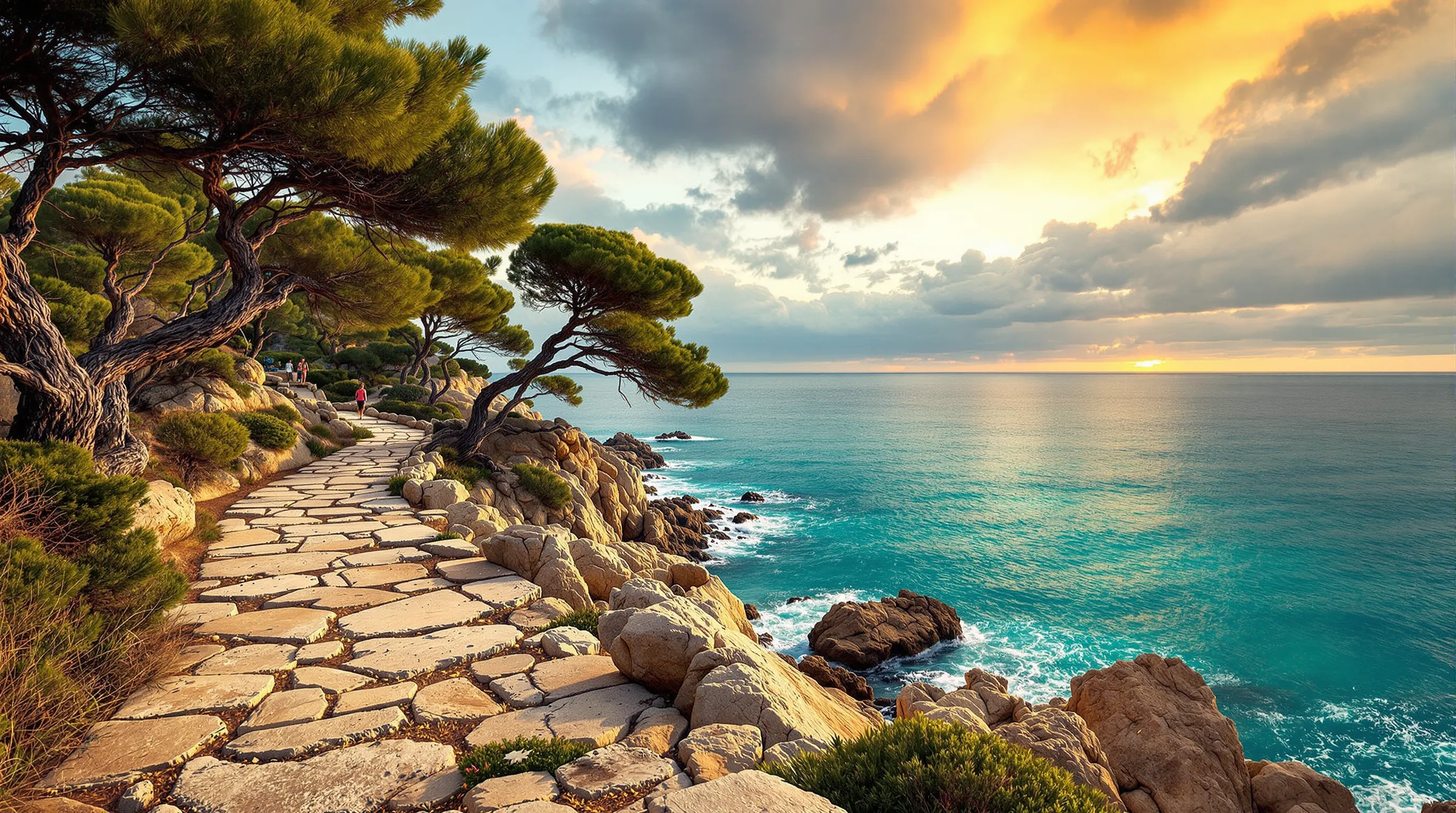
Cap d'Antibes: What the Coastal Path Reveals to Attentive Walkers
The first time I walked the Tirepoil path, early one morning, I stumbled upon a group of free divers watching white bream just beneath the surface, a stone's throw from the Garoupe Lighthouse. This coastal path around Cap d'Antibes, roughly 5 kilometres long, hugs red schist coves and centuries-old umbrella pines. Few visitors realise it was laid out back in the 1950s to safeguard public access to the shore against property developers. Even today, it offers one of the few free, wild routes between Antibes and Juan-les-Pins, with swimming spots reachable only on foot.
A historic path between grand villas and untamed nature
The Cap d'Antibes coastal path, also known as the Tirepoil path, follows the rocky headland from Garoupe beach all the way to Villa Eilenroc. The route crosses a landscape of contrasts: on one side, the walls of historic private estates such as Villa Eilenroc, former home of the Beaumont family; on the other, waves crashing against the reddish rocks typical of the Esterel. Mediterranean vegetation - Aleppo pines, myrtle and mastic trees - clings to the rocky crevices, creating a microclimate where you might spot ocellated lizards basking in the sun. The path was reopened to the public in the 1950s after a lengthy legal battle between landowners and the local council, an early example of coastal preservation well before France's 1986 Coastal Law. Today it forms a protected ecological corridor, listed as a Natura 2000 site for its rare cliff-dwelling flora. Walking here means tracing the memory of the Riviera as much as exploring a natural space.
Villa Eilenroc and its listed park
At the far end of the path, Villa Eilenroc, built in 1867 by architect Charles Garnier, opens its 11-hectare park to the public on certain days of the week, notably Wednesdays. Here you'll find centuries-old Mediterranean species - olive and cypress trees - planted during the golden age of the Riviera's winter resorts. The recently restored rose garden is well worth a detour before heading back onto the path towards the nearby rocky coves.
Exactly where to walk and swim on the Cap
The classic starting point is Garoupe beach, reached via Boulevard de la Garoupe in Antibes, though the public car park often fills up in summer. The path then continues towards Pointe Bacon, skirting the Baie des Milliardaires before reaching the Anse de l'Argent Faux, a sheltered cove popular for swimming in deep, clear water. Further along, Garoupe beach itself offers fine sand suited to families, while the rocky coves near Villa Eilenroc are better suited to experienced swimmers due to the uneven seabed and sea urchins. On the Juan-les-Pins side, Pointe de l'Ilette offers another, shorter starting point for those wanting a one-hour there-and-back walk. The Garoupe Lighthouse, perched above, remains an essential landmark, with a 360-degree view over the Golfe de la Napoule, the Lérins Islands and, on a clear day, even Corsica.
Hidden coves around the Baie des Milliardaires
Between Pointe Bacon and the Anse de l'Argent Faux lie small coves accessible only on foot, with no sand but rocky platforms perfect for diving in. The water here is noticeably cooler and clearer than at Antibes' town beaches, as these coves remain less crowded, exposed to the wind and free of any tourist infrastructure.
When to go to avoid the crowds and enjoy the water
Cap d'Antibes is best visited between May and June, or in September, when the water temperature already exceeds 20°C without the crowds of high summer. In July and August, the path remains walkable early in the morning, before 9am, or in the early evening after 6pm, to avoid the heat and congestion on the narrower stretches near Garoupe. Winter, from November to March, offers a completely different experience: sometimes choppy seas, dramatic sea spray, but spectacular low light on the rocks and near-total solitude. The Mistral and easterly winds can make certain sections hazardous during heavy swells, particularly near Pointe Bacon, where waves sometimes wash right across the path. It's worth checking the marine weather forecast before setting off, especially outside the summer season. Spring remains my favourite time to see the rock roses and spurges in bloom along the path - a quiet but remarkable sight for those who take the time to stop and look.
How to plan your coastal walk
Allow around 2 to 3 hours to complete the full Tirepoil path at a leisurely pace, including swimming breaks. The walk is manageable for most abilities, but certain rocky sections near Pointe Bacon call for closed shoes with a good grip - flip-flops are best avoided on the slippery stretches. Be sure to bring water, a hat and sun cream, as shade is scarce except beneath the pines near Villa Eilenroc. For swimming, water shoes are recommended in the rocky coves, where sea urchins and uneven seabeds are common. Driving from Antibes or Juan-les-Pins is possible, but the Garoupe car parks fill up by 10am in season; cycling or walking from the town centre is a sensible alternative. No booking is needed for the public path, though Villa Eilenroc's opening hours vary by season, so it's worth checking before you go.
The best route for a half-day round trip
Set off from Garoupe beach around 8am, follow the coast to the Anse de l'Argent Faux for a first swim around 9.30am, then continue on to Villa Eilenroc to visit the park if the opening day coincides with your visit. Returning the same way allows for a second swim in the late morning, before the crowds build noticeably on the narrower stretches.
Practical tips and responsible tourism
The budget for this outing remains modest: access to the path and coves is free, with only paid parking or the occasional visit to Villa Eilenroc likely to add a variable cost depending on the season. Budget a little more in high season if you opt for a supervised car park rather than walking from the town centre. Environmentally speaking, Cap d'Antibes is home to marine flora and fauna sensitive to trampling and litter, so always take your rubbish home with you and avoid picking the protected cliff-dwelling plants. Out at sea, if you happen to spot dolphins offshore - which does occasionally happen from the Cap's coves - keep a reasonable distance and never attempt to approach them by swimming, in line with the recommendations of the ACCOBAMS agreement on the conservation of cetaceans in the Mediterranean. High Quality Whale Watching-certified operators, based notably in Antibes and Golfe-Juan, follow strict distance and approach-speed protocols that limit the stress caused to the animals. Choosing these certified operators over an improvised outing remains the most responsible way to observe marine life without disturbing it.
Frequently asked questions
Is the Cap d'Antibes coastal path open all year round?
Yes, it remains open throughout the year, though certain sections near Pointe Bacon may be temporarily closed by the local council during heavy swells or strong Mistral winds, for safety reasons. Check the marine weather forecast before heading out in autumn and winter.
Can you swim anywhere along the Tirepoil path?
No, swimming is only possible in certain coves, such as the Anse de l'Argent Faux or near Garoupe beach. Many stretches are lined with steep rocks with no safe access to the water, so it's best to look out for marked entry points or spots already used by other swimmers.
How long does it take to walk the whole coastal path?
Allow 2 to 3 hours for the full there-and-back walk between Garoupe beach and Villa Eilenroc, including swimming stops. Without stopping, a continuous walk takes around 1.5 to 2 hours depending on your pace and sea conditions on the rocky sections.
Do you need special shoes to walk on Cap d'Antibes?
Closed shoes with a good grip are recommended, particularly near Pointe Bacon, where the rocks become slippery in rough seas. For swimming in the coves, water shoes help avoid injury on the rocky seabed and offer protection from the sea urchins common in the area.
Can you spot dolphins from Cap d'Antibes?
Occasional sightings of dolphins offshore are possible from the higher coves of the Cap, particularly in spring and autumn. For a supervised and respectful experience, it's best to book with High Quality Whale Watching-certified operators departing from Antibes or Golfe-Juan, rather than attempting to spot them informally from the coast.
The Cap d'Antibes coastal path remains one of the finest ways to combine an accessible walk, wild swimming and historic heritage on the French Riviera, provided you choose the right season and respect this fragile natural environment. Between hidden coves, Villa Eilenroc and views over the Golfe de la Napoule, each season reveals a different face of the Cap. To continue this exploration of the Mediterranean coastline further out to sea and its most elusive residents, the dolphins, take a look at our guides to responsible dolphin watching at dauphin-mediterranee.com.
Read also

What to Do in Nice by the Sea: The Local Guide Rushed Tourists Miss
Local guide to Nice by the sea: beaches, coves, water sports and boat trips. Exp...

Saint-Tropez differently: the secret coves tourists never find
Discover Saint-Tropez differently: wild coves, hidden inlets and boat trips away...

Motorhoming the Mediterranean: the secret spots most van-lifers never find
Motorhome touring on the Mediterranean coast: authentic spots, nature-friendly s...

Mediterranean Road Trip: The Locals' Secret for Spotting Dolphins and Coves
French Mediterranean coast road trip itinerary: stops, dolphin-watching spots, s...