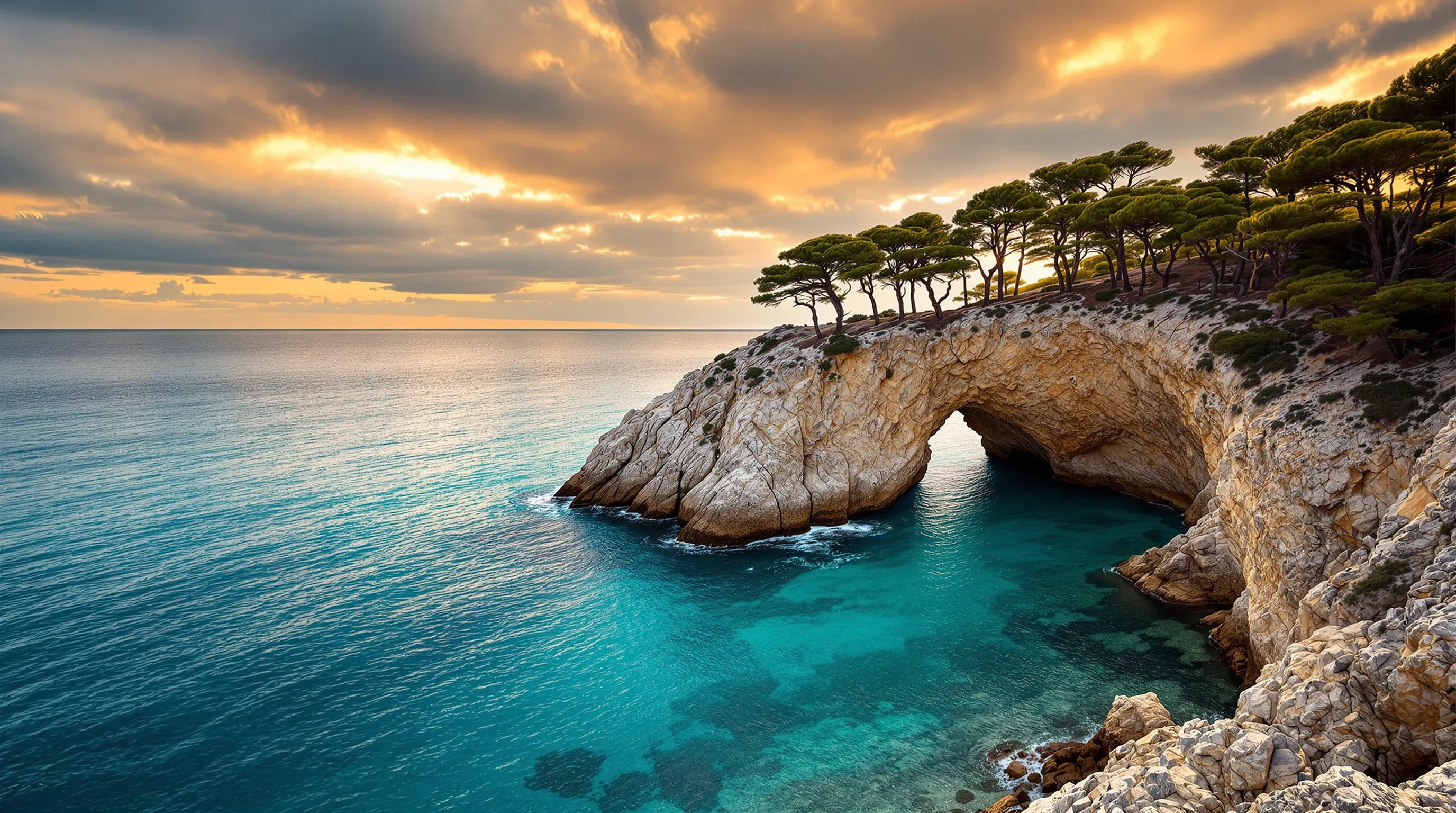
La Ciotat: what lies beneath the turquoise surface at Bec de l'Aigle
The first time I dived beneath the Bec de l'Aigle, a rock formation that traces the silhouette of an eagle poised for flight, I understood why the locals of La Ciotat call this coastline their hidden treasure. Just a stone's throw from Marseille, La Ciotat combines wild calanques, accessible wrecks and an underwater landscape shaped by puddingstone, a unique conglomerate rock found nowhere else in the Mediterranean. Birthplace of cinema and home to historic shipyards, the town also offers a marine playground far less crowded than Cassis or the Calanques National Park near Marseille. Here's what you need to know before diving in, walking the coastal path, or simply gazing at the horizon.
Bec de l'Aigle, La Ciotat's geological sentinel
The Bec de l'Aigle towers over the Mugel bay with its 155 metres of red puddingstone, a sedimentary rock made of pebbles cemented together by an iron-rich matrix, unique along this stretch of coast. Viewed from out at sea, the rocky profile does indeed resemble an eagle's head, a result of differential erosion that has sculpted the cliff face over millennia. This protected site serves as an unmissable landmark for divers and walkers following the coastal path between Mugel Park and the Figuerolles calanque. Underwater, the puddingstone drop-offs create crevices and overhangs colonised by red coral in the depths and gorgonian fans higher up. These waters are also home to shoals of saupe, forkbeard hiding in crevices, and occasionally curious common dentex. Mugel Park, a former private estate now a municipal botanical garden, provides a shady starting point beneath Aleppo pines for admiring the rock formation without getting your feet wet—a favourite with families.
A rare geological formation in the Mediterranean
The puddingstone of Bec de l'Aigle formed around 100 million years ago from an accumulation of pebbles in an ancient river delta. This highly erosion-resistant conglomerate rock explains the rugged terrain and deep coves that characterise the entire La Ciotat coastline as far as the Figuerolles calanque. Geologists regard this site as an exceptional example of ancient Provençal coastal landscapes.
Where exactly to go around La Ciotat
The Figuerolles calanque, reachable via a fifteen-minute walk from a roadside car park along the Liouquet corniche, remains the most photographed spot. Its red puddingstone cliffs frame a pebble cove perfect for swimming and early-morning snorkelling. Further south, the Oule calanque and Cap de l'Aigle calanque require a longer walk but offer rare tranquillity, particularly outside July and August. For diving, the local club runs trips out to the wreck of the Liban, a passenger liner sunk in 1903 off Île Verte, now covered in gorgonian fans and frequented by forkbeard and occasionally impressive conger eels. Île Verte itself, the only wooded island along the coast between Marseille and Toulon, is reached by a ten-minute shuttle boat from the old harbour and offers a shaded trail with views over the historic shipyards. La Ciotat's harbour serves as the logistical hub: kayak hire, FFESSM-approved diving clubs and shuttle boats to Île Verte are all based here. For dolphin watching out at sea, head to the Pelagos Sanctuary, a protected zone covering part of the gulf between La Ciotat and Corsica, accessible via guided trips departing from the harbour.
Île Verte, a nature escape just a short boat ride away
Designated as a partial nature reserve, Île Verte is covered in Aleppo pines, coastal trails and the remains of Fort Saint-Pierre. The shuttle from the old harbour runs continuously in season, with a reduced frequency out of summer. Allow half a day for the crossing, a walk around the island and a swim in its sheltered coves, which see far fewer visitors than those on the mainland.
When to visit for the best of La Ciotat
June and September remain the most favourable months: comfortable water temperatures of around 21 to 24 degrees, excellent light for diving, and noticeably fewer crowds than in July and August. The Mistral wind, common in spring and autumn, can shut down boat trips for several consecutive days, so it's worth building some flexibility into your plans. July and August bring warmer water, sometimes 25 to 27 degrees, but Figuerolles calanque and Mugel Park get extremely busy from as early as 9am, with parking along the corniche becoming a real headache. For the coastal walk to Bec de l'Aigle, aim for early morning or late afternoon in summer to avoid the heat on the largely unshaded paths. Autumn, particularly October, appeals to experienced divers thanks to often excellent visibility once the summer sea spray has settled, even as the water gradually cools. Winter remains a niche season: the sea is calm on some days, with beautiful low light for photographing Bec de l'Aigle, but few water sports operators are open and the water drops below 14 degrees.
How to plan your visit depending on your level
For the walk between Mugel Park and Figuerolles, allow two to three hours there and back; the path is manageable for occasional walkers but includes a few slippery rocky sections near Bec de l'Aigle, so sturdy footwear is recommended. Swimming and snorkelling at Figuerolles require no particular skill level—a mask and snorkel are all you need to spot the submerged rocks near the cliffs. Diving the Liban wreck, however, is suited to autonomous divers with at least a PADI Advanced Open Water or equivalent qualification, given the depth ranges from 15 to 30 metres depending on the area explored, with mandatory supervision from an FFESSM-affiliated club based at the harbour. Trips to Île Verte can easily be booked on the day during the low season, but plan a few days ahead in July and August. For dolphin watching at sea, choose operators displaying the High Quality Whale Watching label, which guarantees respectful approach protocols towards cetaceans. Allow at least half a day for these trips, pack mineral sunscreen, warm clothing even in summer as the sea breeze can turn chilly quickly, and budget will vary depending on the duration and type of boat chosen.
Essential kit depending on the activity
For wreck diving, a buoyancy compensator, regulator and at least a 5mm wetsuit remain essential even in summer given the depth. For the coastal walk, bring plenty of water, a hat and shoes with good grip. On boat trips, a windproof jacket and binoculars significantly improve the observation experience, especially further out where the wind tends to pick up quickly in the afternoon.
Practical tips and responsible tourism
Costs vary considerably depending on the activity: an independent walk to Figuerolles costs nothing beyond the occasionally charged car park in season, while a guided wreck dive or whale-watching trip represents a more significant investment, depending on duration, equipment provided and group size. Book diving and boat trips at least a week in advance in July and August, as places fill up quickly with the harbour's most reputable clubs. For dolphin watching, ACCOBAMS regulations require a minimum distance of one hundred metres, a lateral approach that never crosses the animals' path, and an immediate engine cut-off if the cetaceans show signs of stress. Choosing an operator certified by the High Quality Whale Watching label guarantees these protocols are followed by staff trained in the biology of local species, mainly striped dolphins and occasionally bottlenose dolphins within the Pelagos Sanctuary. On land, stick to the marked trails at Mugel Park to protect the fragile Mediterranean vegetation, take your rubbish home with you, and avoid disturbing the calanques' wildlife, particularly the shearwaters that nest on certain coastal cliffs in spring.
Frequently asked questions
Can you dive without certification in La Ciotat?
Yes, through introductory dives supervised by an instructor, generally available from age eight, with depths not exceeding six to eight metres. For the Liban wreck, however, a minimum Advanced qualification with a valid certification card is required by the harbour's FFESSM-affiliated clubs.
What's the best time to see dolphins off La Ciotat?
Spring and autumn often bring calmer seas, which favours dolphin watching, but striped dolphins can be found in the Pelagos Sanctuary all year round. Choose operators certified by the High Quality Whale Watching label to maximise your chances while respecting the animals.
How can you reach Figuerolles calanque without a car?
A local bus connects La Ciotat town centre to the vicinity of the Liouquet corniche, followed by a fifteen-minute walk along the path. During peak season, check the reduced timetables and allow some margin, as the last return service can be surprisingly early.
Is Île Verte suitable for families with children?
Absolutely, the shuttle crossing takes around ten minutes and the coastal trail is manageable for children from about six or seven years old. The sheltered coves allow for safe swimming, particularly in the morning before the afternoon crowds arrive.
Do you need to book the Liban wreck dive in advance?
In July and August, book at least a week ahead, as the harbour's clubs fill up quickly at weekends. Outside peak season, booking two or three days in advance is usually sufficient, unless unfavourable sea conditions force cancellations.
Between the red puddingstone of Bec de l'Aigle, the secret coves of Figuerolles and the gorgonian-carpeted seabed around the Liban wreck, La Ciotat deserves far more than a quick stopover. Each season reveals a different face, from the low winter light to the turquoise waters of June. By choosing responsible operators and respecting approach distances for cetaceans, you help preserve this exceptional stretch of coastline. To deepen your knowledge of Mediterranean dolphins and plan a respectful sea trip, explore our complete guides at dauphin-mediterranee.com.
Read also

Cap d'Antibes: What the Coastal Path Reveals to Attentive Walkers
Discover the Cap d'Antibes coastal path: hidden coves, wild swimming and Mediter...

What to Do in Nice by the Sea: The Local Guide Rushed Tourists Miss
Local guide to Nice by the sea: beaches, coves, water sports and boat trips. Exp...

Saint-Tropez differently: the secret coves tourists never find
Discover Saint-Tropez differently: wild coves, hidden inlets and boat trips away...

Motorhoming the Mediterranean: the secret spots most van-lifers never find
Motorhome touring on the Mediterranean coast: authentic spots, nature-friendly s...