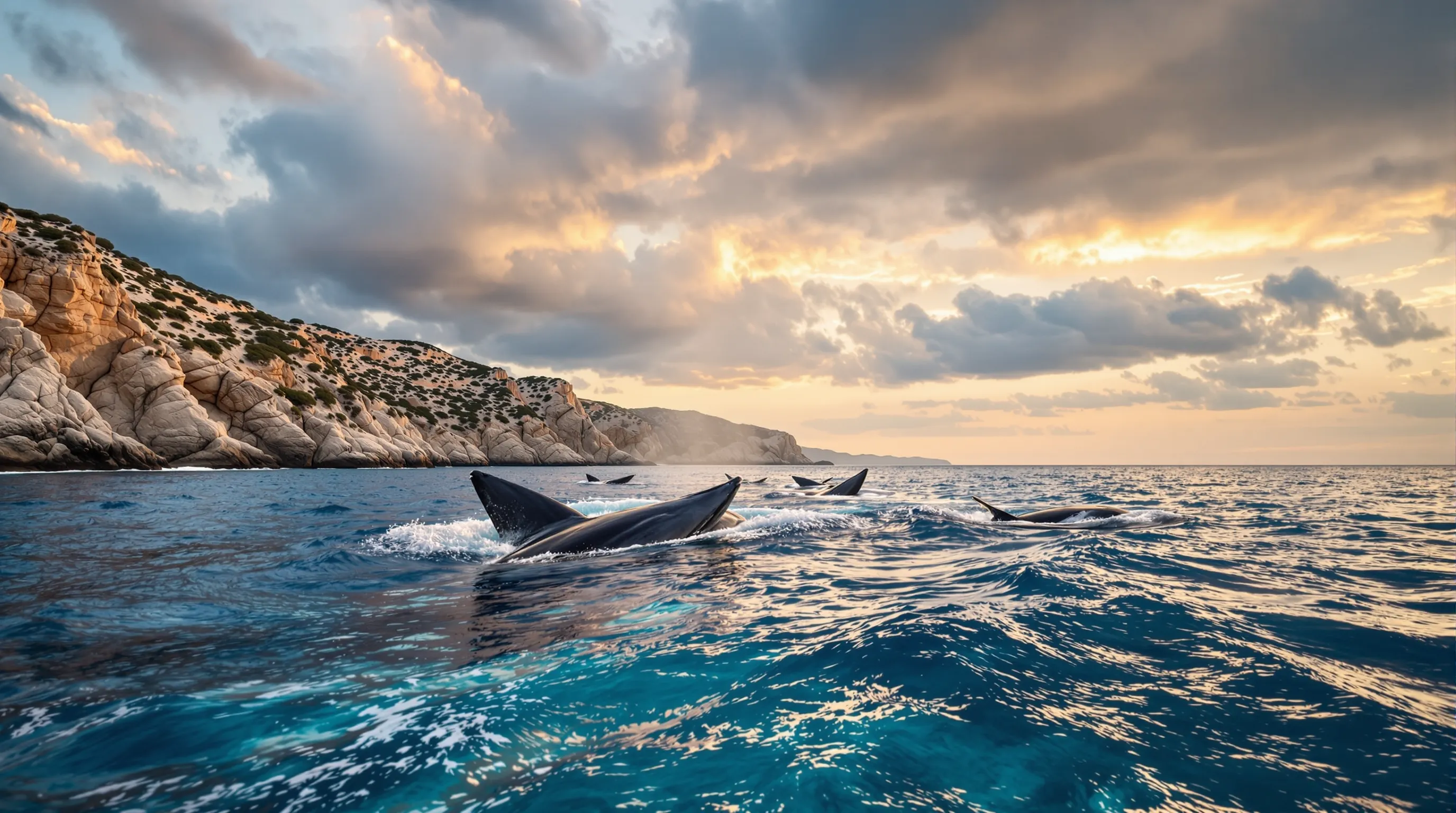
What you didn't know about fin whales, the Mediterranean giants that captivate
The fin whale, the world's second-largest marine mammal after the blue whale, has roamed Mediterranean waters for millennia. Measuring up to 24 metres and weighing 80 tonnes, this ocean giant fascinates scientists and tourists alike. Contrary to popular belief, the Mediterranean hosts a resident population of 3,500 to 4,000 individuals, concentrated primarily in the Pelagos Sanctuary between France, Monaco, and Italy. These majestic creatures dive for 15 minutes to depths of 200 metres to feed on krill and small pelagic fish.
Unique characteristics of Mediterranean fin whales
Mediterranean fin whales display remarkable adaptations to their environment. Their cruising speed of 25 km/h makes them the fastest marine mammal, capable of reaching 40 km/h when threatened. Their asymmetrical morphology is fascinating: the right jaw is white whilst the left remains dark, an adaptation linked to their spiral hunting technique. Mediterranean populations are smaller than their Atlantic cousins, averaging 18-20 metres in length. Their diet consists primarily of euphausiids and anchovies, requiring consumption of 2 tonnes of food daily. Females give birth every 2-3 years after an 11-month gestation period.
Easy identification through physical characteristics
Fin whales are easily recognised by their cone-shaped blow reaching 6 metres in height, visible from several kilometres away. Their triangular dorsal fin, positioned two-thirds along the body, emerges simultaneously with the blow. Ventral grooves, between 50 and 100 pleats, allow throat expansion during feeding. The grey-brown colouring of the back contrasts with the pearlescent white belly.
Prime observation areas in the Mediterranean
The Pelagos Sanctuary remains the most productive observation zone, covering 87,500 km² between Toulon, the tip of Sardinia, and the mouth of the River Tiber. Submarine canyons off Monaco and Nice concentrate 60% of summer sightings thanks to nutrient-rich upwellings. The Strait of Bonifacio between Corsica and Sardinia also offers excellent opportunities from April to October. Observation zones extend from the Gulf of Lion to the Ligurian coast, with hotspots identified 20-30 nautical miles offshore where depths exceed 2,000 metres. Optimal conditions combine calm waters, winds below 15 knots, and glass-calm morning seas. The period from May to September guarantees an 80% success rate for sightings.
Behaviour and seasonal migrations
Mediterranean fin whales follow a complex migratory cycle linked to food availability. In summer, they concentrate in Ligurian-Provençal waters where coastal upwellings promote krill production. Autumn marks dispersal towards warmer waters of the western basin. Their social behaviours vary seasonally: groups of 6-10 individuals during feeding periods, mother-calf pairs visible from May to August. Feeding dives last 8-15 minutes, followed by 4-5 surface breaths. The fin whale's song, emitted at 15-25 Hz, can travel 1,000 kilometres and plays a crucial role in reproduction and long-distance communication.
Sophisticated feeding techniques
Fin whales employ a unique lateral feeding technique, turning onto their right side to engulf schools of prey. This method explains the asymmetrical colouring of their head. Baleen plates, numbering 300-400 on each side, filter up to 70 tonnes of water per mouthful. The throat can expand to four times its normal size.
Practical tips for whale watching at sea
Observing fin whales requires careful preparation and adherence to regulations. Excursions depart primarily from Monaco, Nice, Cannes, Sanary-sur-Mer, and Sète, with prices ranging from £40 to £75 per adult depending on duration (half-day or full-day trips). The optimal period runs from May to October, with peak demand in July-August requiring bookings a fortnight in advance. Morning trips (8am-2pm) offer better weather conditions and increased cetacean activity. Recommended equipment includes high-factor sun cream, cap, 8x42 binoculars, warm clothing, and sea-sickness medication. Boats maintain a minimum distance of 100 metres and reduced speed when animals are present.
Frequently asked questions
What's the best time to spot fin whales in the Mediterranean?
The optimal period runs from May to October, with peak sightings in June, July, and August. During this period, 80% of trips result in at least one sighting. Weather conditions are more favourable and prey concentration attracts more fin whales to the waters of the Pelagos Sanctuary.
How much does a whale watching excursion to see fin whales cost?
Prices range from £40 to £75 per adult depending on duration and departure port. Half-day trips (4-5 hours) typically cost £40-55, whilst full-day excursions reach £60-75. Children often receive 30-50% discounts. Booking a fortnight in advance is recommended during peak season.
Can you spot fin whales from the French Mediterranean coastline?
Coastal observation remains exceptional as fin whales typically roam 20-30 nautical miles offshore in deep-water zones. Only elevated headlands such as Cap d'Antibes or Cap Bénat occasionally offer distant sightings with powerful binoculars, but a sea trip remains essential for quality observation.
Mediterranean fin whales represent one of the most striking natural spectacles along our shores. These ocean giants, true guardians of marine biodiversity, offer privileged observers moments of pure emotion. To experience this unique encounter and discover other treasures of Mediterranean wildlife, check observation programmes on dauphin-mediterranee.com and set off to meet these ocean ambassadors.
Read also
Why Mediterranean Fishermen Jealously Guard These 7 Ancestral Recipes
Discover the culinary secrets of the Mediterranean coast: traditional fish recip...
7 Fascinating Things You Didn't Know About Long-finned Pilot Whales in the Mediterranean
Discover the secrets of long-finned pilot whales in the Mediterranean: behaviour...
These Mediterranean Wrecks Will Transform Your Scuba Diving Passion
Discover the legendary Mediterranean shipwrecks for scuba diving. Exceptional si...

Why Provençal Waters Transform Your Kayaking and Paddleboarding Experience
Discover why kayaking and paddleboarding along the Provençal coast offers unique...