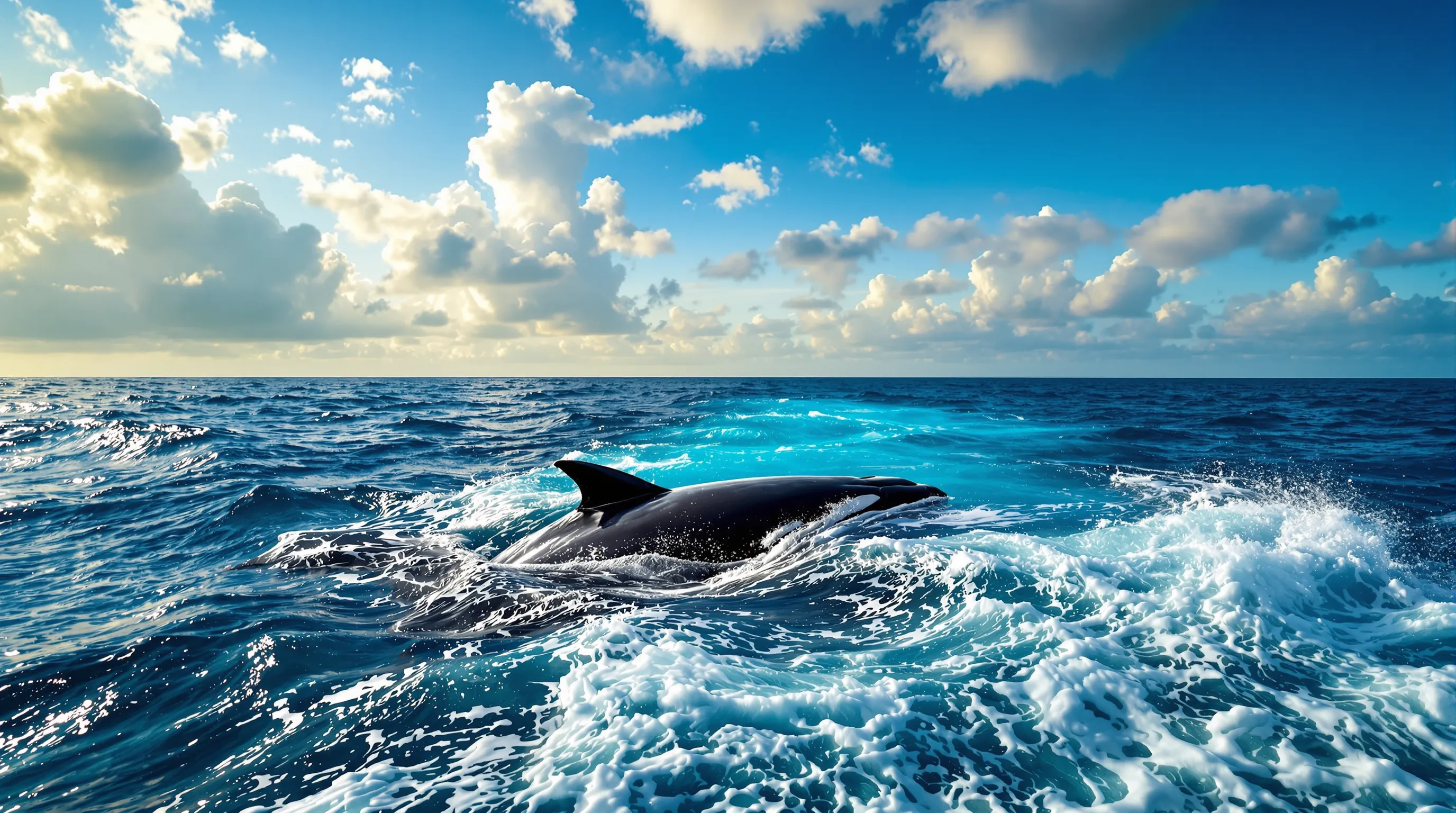
7 Fascinating Things You Didn't Know About Long-finned Pilot Whales in the Mediterranean
Long-finned pilot whales (Globicephala melas) rank amongst the most misunderstood cetaceans in the Mediterranean. These dolphin cousins, measuring up to 6 metres, move in tight-knit family groups through deep waters. Unlike the more playful dolphins, they adopt a discrete and mysterious behaviour. Present year-round in the western Mediterranean, particularly off French, Spanish and Italian coasts, they offer patient observers truly exceptional moments. Their remarkable intelligence and complex social structure have fascinated scientists for decades.
Physical characteristics and profile of long-finned pilot whales
Long-finned pilot whales are distinguished by their characteristic bulbous forehead and sleek, glossy black body. Adult males reach 6 metres and weigh 3 tonnes, whilst females measure approximately 4.5 metres. Their dorsal fin, positioned towards the front of the body, has a distinctive sickle shape. These cetaceans possess between 7 and 12 conical teeth per jaw, perfectly adapted to their diet. Their life expectancy exceeds 60 years for females, compared to 45 years for males. This exceptional longevity directly influences their matriarchal social structure, where elderly females lead family groups.
Remarkable physiological adaptations
Their diving capabilities are impressive: they regularly descend to 500 metres depth and can hold their breath for 15 minutes. Their brain, proportionally larger than that of bottlenose dolphins, demonstrates their exceptional intelligence. Their complex vocalisations include echolocation clicks and whistles specific to each family pod.
Social behaviour and unique family structure
Long-finned pilot whales live in pods of 10 to 30 individuals, led by an experienced matriarch. These family groups remain bonded throughout their lives, creating exceptional intergenerational connections. Young males occasionally leave the group to breed but often return. This family loyalty explains their tragic mass strandings: when one individual strands, the entire group follows out of solidarity. Their sophisticated communication system includes dialects specific to each family. Post-menopausal females play a crucial role, guiding the group through their experience and knowledge of feeding areas. This matriarchal structure favours the transmission of knowledge between generations.
Habitat and distribution in the Mediterranean
In the Mediterranean, long-finned pilot whales prefer deep waters beyond 200 metres, particularly submarine canyons rich in squid. The Pelagos Sanctuary, between France, Monaco and Italy, constitutes their preferred zone. They are regularly observed off Nice, the Hyères Islands, the Gulf of Lion and the Balearics. These areas concentrate their favourite prey: squid, cuttlefish and deep-water fish. Their presence varies seasonally: more numerous in summer near French coasts, they migrate southward in winter. Coastal upwellings, cold water currents rich in nutrients, particularly attract them. This distribution directly influences observation opportunities from Mediterranean ports.
Prime observation zones
Trips from Antibes, Nice or Toulon offer the best chances of encounters between May and September. The Rech Lacaze-Duthiers and Var canyons concentrate numerous sightings. In Spain, the deep waters off Tarragona and the Balearics are equally promising.
Practical tips for observing pilot whales
Observing long-finned pilot whales requires patience and preparation. Sea trips of 6 to 8 hours from Mediterranean ports cost between £40 and £70 per adult. The optimal period extends from May to October, with a peak in July-August. Book your trips 48 hours in advance, as weather conditions strongly influence departures. Bring sun cream, warm clothing and seasickness remedies. 8x42 binoculars significantly improve the experience. Choose respectful operators applying the regulatory 100-metre distances. Morning trips often offer better sea conditions and lighting for photography and observation.
Frequently asked questions
What's the best time to observe long-finned pilot whales in the Mediterranean?
The optimal period extends from May to October, with peak sightings in July-August. Weather conditions are more favourable then, and pilot whales are more active near Mediterranean coasts, particularly in the Pelagos Sanctuary.
How can you distinguish a pilot whale from a dolphin during a sea trip?
Long-finned pilot whales are recognisable by their distinctive bulbous forehead, entirely black body, impressive size (up to 6m) and sickle-shaped dorsal fin positioned forward. They swim more slowly than dolphins and remain in compact groups.
How much does a pilot whale watching trip cost from French ports?
Prices range from £40 to £70 per adult for 6 to 8-hour trips. Costs depend on season, departure port and included services. Book in advance, especially during peak summer season.
Long-finned pilot whales reveal the little-known richness of Mediterranean biodiversity. Observing them requires patience and respect, but offers moments of pure emotion facing these giants of the deep. To discover more secrets of Mediterranean cetaceans and organise your whale watching trips, visit dauphin-mediterranee.com, your expert guide for encountering the exceptional marine wildlife of our coasts.
Read also

These Mediterranean Wrecks Will Transform Your Scuba Diving Passion
Discover the legendary Mediterranean shipwrecks for scuba diving. Exceptional si...

Why Provençal Waters Transform Your Kayaking and Paddleboarding Experience
Discover why kayaking and paddleboarding along the Provençal coast offers unique...

What local guides reveal about kayaking in the Provençal Mediterranean
Discover the secrets of kayaking and paddleboarding along the Provençal coast: h...

Why These 8 Secret Harbours Transform Your Mediterranean Journey into an Adventure
Discover 8 hidden picturesque harbours along the Mediterranean coast that will r...