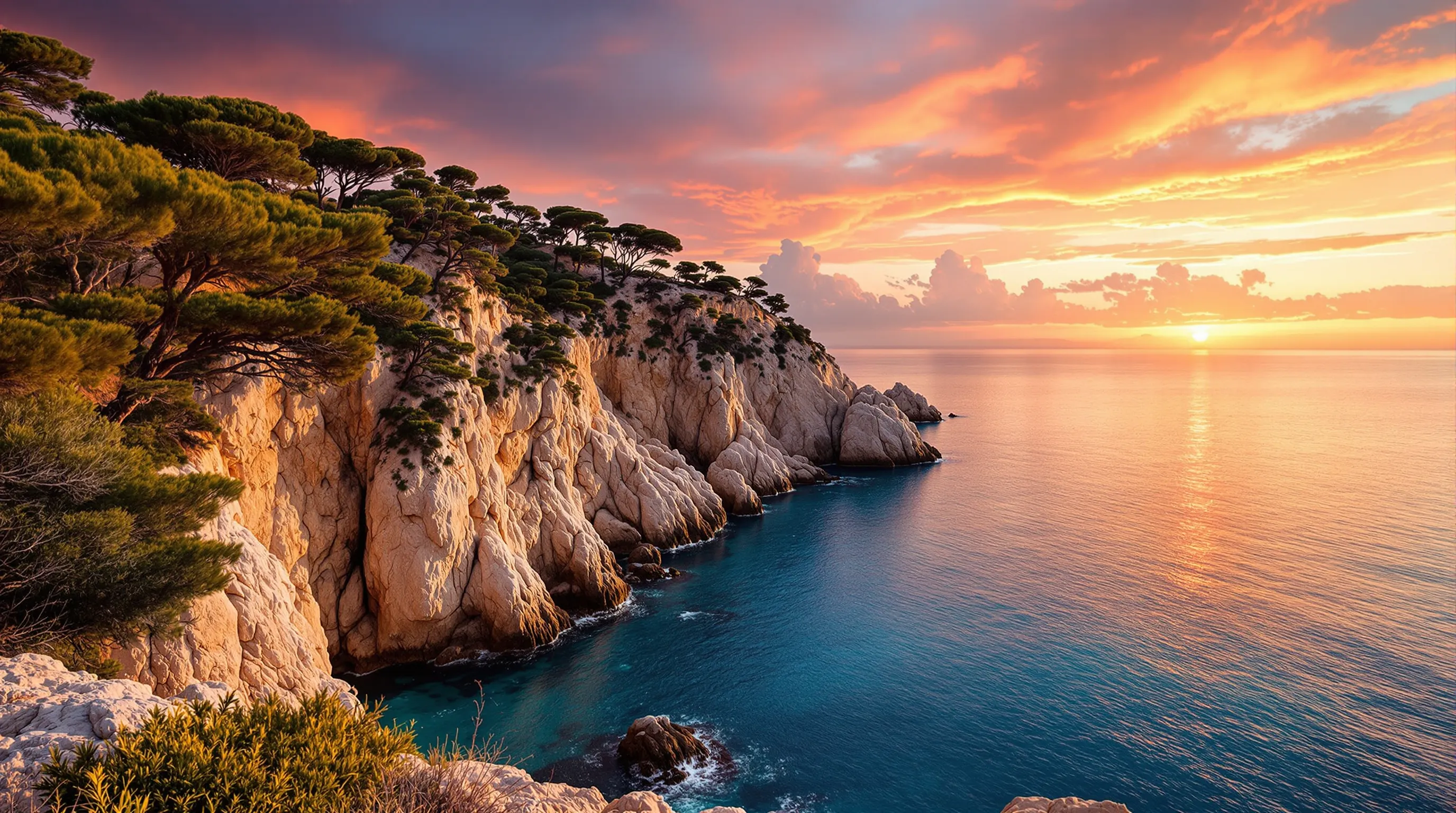
Sunset on the French Riviera: Marina's Favourite Spots to Avoid the Crowds
After fifteen years spent watching cetaceans from the cliffs of Cap Ferrat to the coves of the Estérel, I've finally pinpointed the best spots for sunset watching, the ones tourists still overlook. Last 21 June, from the coastal path at Théoule-sur-Mer, I watched the sky shift from pink to purple in under ten minutes, with the red rocks of the Estérel blazing in the background. This free spectacle, accessible to everyone, remains oddly under the radar. Here are my favourite spots, far from the crowded terraces of Nice or Cannes, to experience this suspended moment between sea and sky.
The hidden coves of the Estérel: a unique mineral landscape
The Estérel massif, between Saint-Raphaël and Mandelieu-la-Napoule, offers a geological playground unlike anywhere else in the Mediterranean, with its red volcanic rock catching the evening light in spectacular fashion. The Anthéor cove, reached via a twenty-minute path from the car park near the train station, lets you watch the sun dip behind the Lérins Islands with the glowing red rocks in the foreground. I've often spotted striped dolphins there in the late afternoon, taking advantage of the evening calm to hunt close to shore. Cap Roux, the massif's highest point at 452 metres, requires a more demanding round trip of about two hours, but the 360-degree view makes it well worth the effort. Watch out for the heat in summer: these shadeless rocky paths become gruelling after 10am, so it's best to save them for late afternoon, just before sunset.
Anthéor cove: easy access for everyone
From the car park near Anthéor-Cap Roux train station, allow 15 to 20 minutes on a waymarked, largely flat path. Wear closed-toe shoes, as the final stretch crosses slippery rocks late in the day. This spot suits families and remains manageable even with children from around 6-7 years old. There's no lighting, so bring a head torch for the walk back.
Nice, Antibes and Cap d'Antibes: where urban life meets unspoilt nature
The Promenade des Anglais in Nice remains a classic, but I'd instead recommend Colline du Château, reached by lift or steps from Old Nice, for an uninterrupted panorama over the entire Baie des Anges without the seafront crowds. The coastal path at Cap d'Antibes, between Plage de la Garoupe and the lighthouse, offers a wilder experience: umbrella pines, rocky coves and a stunning view of the Alps turning pink in the distance. At Villefranche-sur-Mer, Pointe du Cap Ferrat, reached via the Sentier des Douaniers, lets you watch the sun set behind the hills of the Nice hinterland as the lights of Beaulieu gradually flicker on. This 2.5-kilometre path winds through luxurious estates and fragrant Mediterranean gardens, especially lovely in May-June when the pines and rock roses are in bloom.
The Antibes coastal path: coves and pine woods
This roughly 5-kilometre route starts at Plage de la Garoupe and follows the coast to the lighthouse. Allow 1.5 to 2 hours for a leisurely walk with several stops for photos. The terrain, sometimes rocky and narrow, isn't buggy-friendly, but it's manageable for families with children who can walk unaided. Bring water, as there's nowhere to restock along the way.
When to go: seasons, weather and crowds
Spring, from April to June, remains my favourite time for watching sunsets on the French Riviera. The light is soft, the still-cool air limits the summer heat haze that often blurs the horizon in July and August, and the Mediterranean vegetation is in full bloom. Autumn, particularly September and October, delivers spectacular skies with more intense colours thanks to the ambient humidity, which catches the light beautifully. Summer is still possible, but crowds at the best-known spots such as Cap d'Antibes or Théoule-sur-Mer can spoil the experience: arrive at least an hour before the scheduled sunset time to bag a good spot. In winter, between November and February, the sun sets earlier, around 5pm-5.30pm, meaning you can enjoy the show without disrupting your day, with the added bonus of often excellent atmospheric clarity after the mistral has passed through. Always check a marine weather app to see whether low clouds are lurking on the western horizon, as they can completely block the sun in its final minutes.
Planning your outing: timing, kit and good habits
To make the most of a sunset on the French Riviera, plan to arrive 45 minutes to an hour before the official time given by weather apps, allowing time to find your spot and watch the colours gradually shift. Elevated spots such as Cap Roux or Colline du Château require a warm-up walk of anywhere from 20 minutes to 2 hours, depending on how much of a challenge you fancy. Always bring a light jacket: the temperature drops quickly once the sun disappears, even in summer. Photographers should pack a lightweight tripod and a polarising filter to capture the colour gradients without overexposing the sky. Coastal paths such as those at Cap d'Antibes or Cap Ferrat have no night lighting whatsoever: a head torch or a fully charged smartphone torch app is essential for the walk back. Finally, always check tide times if you're planning to reach a cove below sea level, as some Estérel coves become inaccessible at high tide.
Essential kit for a successful outing
Closed-toe walking shoes, a windproof jacket, plenty of water, a head torch and a portable phone charger form the basic kit. Add a light blanket or picnic rug if you plan to settle in comfortably on the rocks. Binoculars are a handy extra: they sometimes reveal dolphins or seabirds also making the most of the evening calm near the rocky coastline.
Practical tips and responsible tourism
Watching a sunset costs nothing, but reaching certain spots can involve parking charges, which vary by town and season and are generally higher in July and August. Book your parking space in advance where possible via municipal apps, particularly in Antibes and Villefranche-sur-Mer, where car parks fill up fast in the late afternoon. Environmentally speaking, these coastal paths often cross Natura 2000 sites or protected areas managed by the Conservatoire du littoral: stick to waymarked trails to avoid damaging the Mediterranean vegetation, which is particularly vulnerable to erosion. If you spot dolphins or other cetaceans from the shore, bear in mind the ACCOBAMS guidelines: never attempt to approach by boat within 100 metres, and favour watching from land instead, which is entirely respectful of their peace and quiet. Avoid leaving any litter, even biodegradable items like fruit cores, and take away everything you brought with you. These simple habits help ensure these outstanding landscapes remain unspoilt for future generations of visitors and marine wildlife alike.
Frequently asked questions
What's the best month to see a sunset on the French Riviera?
April, May, September and October offer the best conditions: clear air, pleasant walking temperatures, and often spectacular skies. Summer is still beautiful but busier and sometimes hazy in the late afternoon due to heat building up over the coastal ranges.
Can you see dolphins during a sunset from the coast?
Yes, it's possible, particularly from rocky headlands such as Cap Roux or Cap Ferrat, where striped dolphins sometimes hunt close to shore in the late afternoon. These sightings remain unpredictable but are more common in spring and autumn, when boat traffic is lighter.
Do you have to pay to access the best sunset spots?
Access to coastal paths and viewpoints is generally free. Only parking may come with a charge, depending on the town and season, with higher rates in summer. Some car parks allow online booking to guarantee a space in the evening.
Which spot is best for young children?
Anthéor cove and Colline du Château in Nice remain the most accessible, with short, gentle paths. Avoid Cap Roux or the longer Cap d'Antibes trails, better suited to children aged 7-8 and up who can walk confidently, given the rocky terrain.
How can I photograph a sunset without professional equipment?
A recent smartphone is more than enough: switch on HDR mode, avoid digital zoom, which degrades quality, and take your shots a few minutes before the exact moment of sunset, when the colours are at their most vivid. A mini tripod helps steady the shot in low light.
From the red coves of the Estérel to the wild paths of Cap d'Antibes, the French Riviera is brimming with authentic spots to watch the sun sink into the Mediterranean, far from the crowds and the tourist clichés. Pick the right season, pack a bit of basic kit, and respect these fragile natural environments, which are also home to remarkable marine wildlife. To continue the experience and discover the best spots for dolphin and whale watching in the Mediterranean, find all our expert tips at dauphin-mediterranee.com.
Read also

Mediterranean Whale-Watching Calendar: Which Animal to Spot Each Season
Fin whales, dolphins, sperm whales: discover the Mediterranean cetacean calendar...

Boat Trip Bag: What Marina Always Brings Aboard
What should you pack for a boat trip? The complete guide from a marine biologist...

The Aresquiers: 5 secrets of a wild coastline few tourists know about
Discover the Aresquiers, a wild gem of the Languedoc coast: lagoons, salt marshe...

Calanques between Marseille and Cassis: the secret few visitors know about
Discover the most beautiful calanques between Marseille and Cassis: Sormiou, Sug...