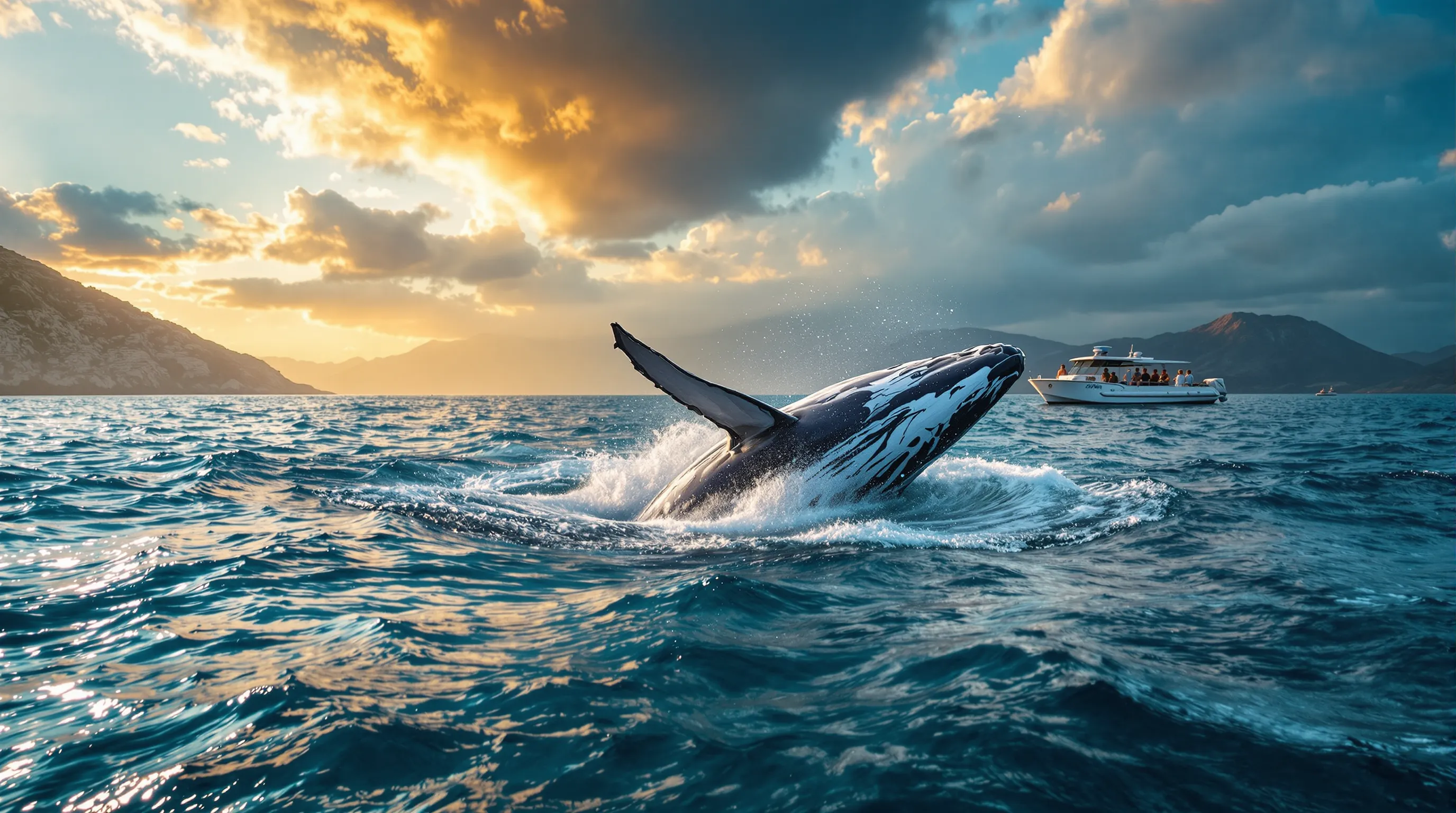
Pelagos Sanctuary: 7 Secrets About the Mediterranean Whale Refuge
The first time I saw a fin whale's blow burst up off the coast of Nice, I understood why this area deserves its sanctuary status. The Pelagos Sanctuary covers more than 87,000 km² between France, Monaco and Italy, making it the largest marine protected area dedicated to cetaceans in the Mediterranean. Eight species live there permanently, including the fin whale, the second-largest animal in the world after the blue whale. Established in 1999 through a tripartite agreement, this sanctuary remains largely unknown to the general public, despite hosting one of the highest concentrations of cetaceans in the western Mediterranean basin.
What exactly is the Pelagos Sanctuary
The Pelagos Sanctuary was created through an agreement signed in 1999 between France, Monaco and Italy, which came into force in 2002. This marine protected area stretches from the mainland to Corsica and Sardinia, encompassing the waters of the Gulf of Lion, the Ligurian Sea and the northern Tyrrhenian Sea. Its distinctive feature: it's not a classic national park with strict navigation bans, but a jointly managed space where shipping traffic, fishing and regulated tourist observation all coexist. The name Pelagos comes from ancient Greek and means 'open sea', a nod to the sanctuary's pelagic character, well away from shallow coastal zones. This particular bathymetry, with deep underwater trenches close to the continental shelf, explains the richness of marine life: the Var canyon off Nice or the deep waters off Toulon create upwellings that bring essential nutrients to the surface for krill and small fish, the foundation of the large cetaceans' diet. The Pelagos agreement also fits within the broader framework of ACCOBAMS, the international agreement on the conservation of cetaceans in the Black Sea, Mediterranean and adjacent Atlantic area, which sets the approach rules that all whale watching operators must follow.
The sanctuary's eight iconic species
The fin whale dominates, with a resident summer population estimated at several hundred individuals. The sperm whale, a record-breaking diver capable of descending over 1,000 metres, frequents the continental shelf year-round. The striped dolphin remains the most commonly observed species, often in groups of dozens of individuals. Bottlenose dolphins are also found closer to shore, along with pilot whales, Risso's dolphins recognisable by their scarred skin, and, more rarely, Cuvier's beaked whale, an elusive deep-diving cetacean.
Where to spot cetaceans in the Pelagos Sanctuary
Several harbours serve as departure points for the sanctuary's deep waters. On the French Riviera, Nice marina and the port of Cannes offer quick access to the underwater canyon, roughly two hours by boat. Toulon and its harbour form another strategic base, with trips heading offshore where the continental shelf drops away sharply. In Corsica, Calvi and Bastia provide access to the deep waters of the Corsican-Ligurian-Provençal strait, a regular migration corridor for fin whales in summer. On the Italian side, Genoa, Savona and the Tuscan archipelago, particularly around Elba, are historic bases for both scientific and tourist observation. Some associations run trips from Antibes and Saint-Raphaël, closer to shore but still offering encounters with resident dolphins. It's worth knowing that cetacean presence varies significantly from year to year depending on oceanographic conditions: a summer with strong upwelling off Nice will attract more fin whales than a season with more stable waters. Reputable operators, often linked to research institutes such as WWF France or the Souffleurs d'Écume association, adjust their routes based on recent sightings rather than following a fixed circuit.
The busiest French harbours
Nice remains the most popular departure point thanks to its proximity to the Var canyon, a trench that plunges to over 2,000 metres. Toulon offers direct access to similarly deep waters. From both harbours, expect a trip lasting four to six hours to maximise your chances of a sighting, as cetaceans are rarely found within an hour's sailing of the coast.
When to go: seasons and weather for whale watching
The optimal period runs from May to September, with fin whale numbers peaking between July and August, when krill and plankton concentrate near the surface as waters warm and currents shift. Spring, from April onwards, marks the gradual return of fin whales migrating up from waters further south to feed. Sperm whales are present almost year-round but are more easily spotted in calm seas, making late spring and summer the best windows. Autumn, particularly September, often brings calmer seas and less mistral wind, making it easier to spot blows on the surface. Winter isn't entirely devoid of activity, but commercial trips are rare due to difficult sea conditions, the frequent mistral in the Gulf of Lion and north-westerly winds in the Ligurian Sea. Swell is another factor to consider: rough seas make observation nearly impossible, and many excursions are cancelled when conditions aren't safe. July and August see the highest tourist numbers, with boats often fully booked, while June and September offer a good balance between favourable weather and more manageable crowds, without compromising your chances of a sighting.
How to plan your whale watching trip
A typical trip lasts between four and eight hours depending on how far the search zones are, with some operators even offering full-day excursions in open water. No particular fitness level is required, but you should feel comfortable at sea: seasickness commonly affects trips lasting several hours in open water, far from the shelter of the coast. Pack warm clothing even in summer, as the wind at sea noticeably lowers the perceived temperature, along with sun protection, your own binoculars and a camera with a telephoto lens if you want to capture the encounter. Children are generally welcome from a certain age, though each operator sets its own minimum age policy. It's essential to choose an operator affiliated with the High Quality Whale Watching label, supported by organisations such as Marineland and scientific associations partnered with the Pelagos Sanctuary, which guarantees respect for approach distances and often includes a naturalist on board who narrates the sighting and raises awareness about the biology of the species encountered. Book several days in advance during peak season, as places on board are limited to avoid stressing the animals.
Essential kit to bring along
A windproof jacket, compact 8x42 binoculars ideal for spotting blows, a cap and polarising sunglasses that cut glare on the water and make it easier to spot surfacing backs. Bring seasickness tablets too if you're prone to it, taken before boarding, along with a water bottle, as long trips in full sun can dehydrate you quickly.
Practical tips and responsible tourism
The cost of a trip varies depending on duration, departure port and whether a scientific naturalist is on board; shorter trips near the coast tend to be more affordable than full days offshore towards the deep canyon. Always favour operators certified with the High Quality Whale Watching label, who commit to following ACCOBAMS recommendations: a gradual, side-on approach to the animals, a minimum distance generally set at 100 metres for most cetaceans and greater for groups with calves, reduced speed on approach, limited observation time to avoid stressing the animals, and a ban on encircling a group or cutting across its path. Never throw waste overboard, even organic matter, and report any sightings to scientific networks such as GIS3M, which coordinate population monitoring within the sanctuary. Where possible, book directly with associations or cooperatives of fishermen who have moved into ecotourism, rather than through generic booking platforms, as this ensures better traceability of practices. Finally, bear in mind that no trip can guarantee a sighting: cetaceans remain wild animals, free to roam as they choose, and that element of uncertainty is part of what makes the experience so special.
Frequently asked questions
What is the Pelagos Sanctuary in the Mediterranean
It's a marine protected area of over 87,000 km² established in 1999 by France, Monaco and Italy to protect Mediterranean cetaceans. It covers the Gulf of Lion, the Ligurian Sea and part of the Tyrrhenian Sea, home to eight species including the fin whale and sperm whale.
What's the best time to see whales in the Pelagos Sanctuary
The ideal period runs from May to September, peaking in July and August for fin whales drawn by concentrations of krill. Sperm whales can be seen almost year-round, but the calmer seas of late spring and summer make them much easier to spot at the surface.
Which harbour should I depart from to see cetaceans in the Pelagos Sanctuary
Nice and Toulon offer quick access to deep water thanks to their proximity to underwater canyons. Calvi and Bastia in Corsica, along with Genoa and Elba on the Italian side, are other well-established departure points for offshore whale watching trips.
What distances should be kept to observe cetaceans without disturbing them
The ACCOBAMS agreement recommends a minimum distance of around 100 metres, greater when calves are present. Approaches should be made from the side and gradually, never cutting across the animal's path or encircling it. Operators certified with the High Quality Whale Watching label formally commit to following these rules.
How long does a whale watching trip in the Pelagos Sanctuary last
Expect trips to last between four and eight hours depending on how far the search zones are, as cetaceans are often found well offshore in deep water. Some operators offer full-day excursions to maximise the chances of encountering fin whales and sperm whales.
The Pelagos Sanctuary represents a rare success story in international cooperation for the protection of Mediterranean cetaceans, offering unforgettable encounters with fin whales, sperm whales and dolphins within a well-regulated and responsible framework. Choosing a certified operator, respecting approach distances and favouring the right seasons all ensure an experience that is both rewarding and respectful of these marine giants. To plan your next trip, compare observation spots or learn more about the biology of Mediterranean species, browse all our expert guides at dauphin-mediterranee.com.
Read also

Microplastics in the Mediterranean: What's Hiding in Our Turquoise Waters
Microplastics in the Mediterranean: where they accumulate, their impact on dolph...
Fin Whales in the Mediterranean: 7 Truths About This Giant That Fascinates Scientists
Discover the fin whale in the Mediterranean: the Pelagos Sanctuary, best times t...
The Legendary Mediterranean Route: What a Well-Planned Coastal Road Trip Reveals
Discover the complete itinerary for a French Mediterranean coastal road trip: st...
Sète and the Thau Lagoon: secrets of a territory between sea and lagoon
Discover Sète and the Thau lagoon: harbours, oysters, coves and marine wildlife....