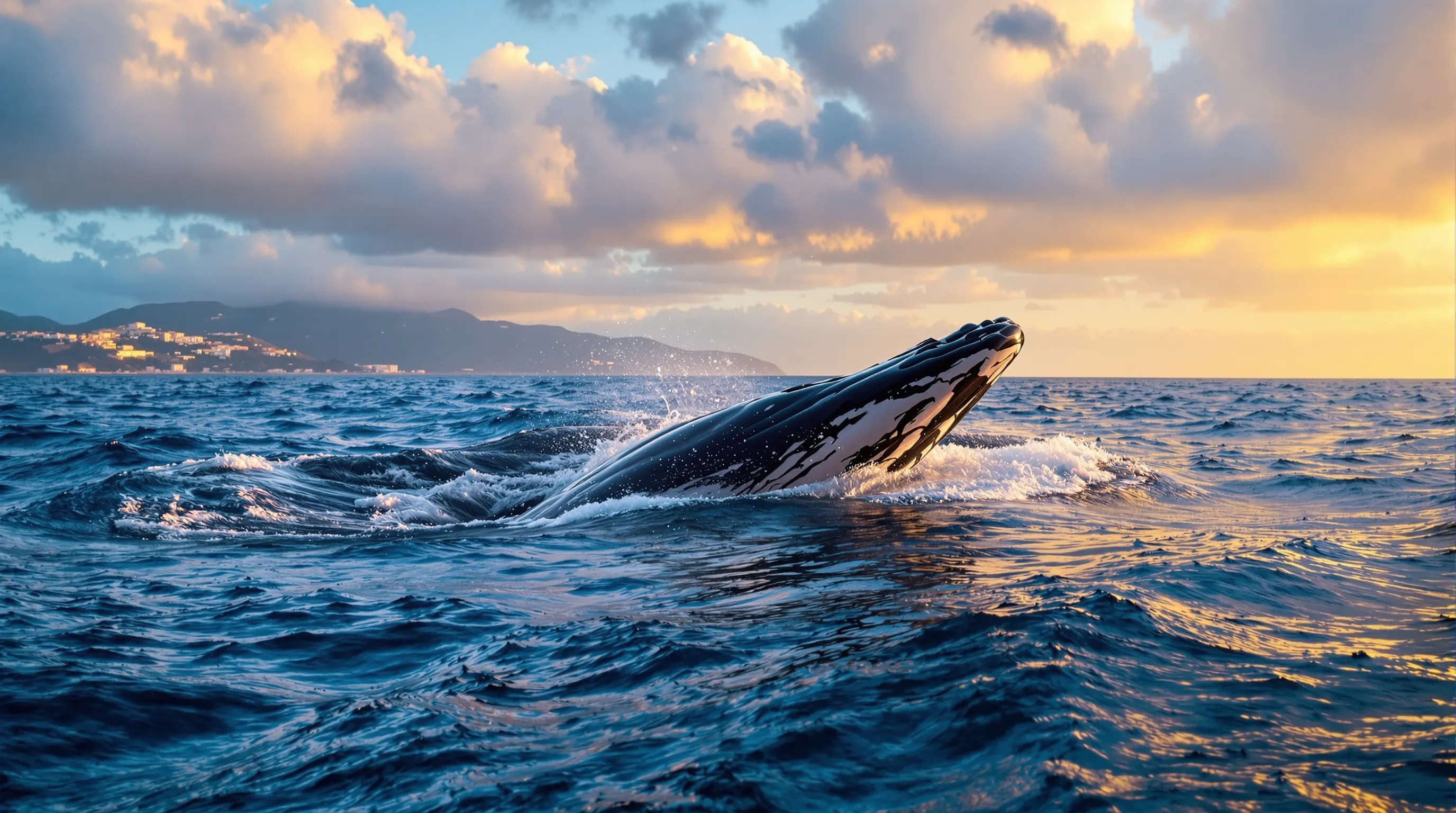
Fin Whales in the Mediterranean: 7 Truths About This Giant That Fascinates Scientists
The first time I saw the spout of a fin whale break the surface off Toulon, I understood exactly why it's called the giant of the seas. At 20 metres long, the second-largest animal on Earth after the blue whale roams the Ligurian-Provençal basin every summer. The Pelagos Sanctuary, an 87,500 km² protected area spanning France, Monaco and Italy, is home to one of the few regular Mediterranean populations of this species. Few travellers realise you can spot them from ports as accessible as Nice or Sanary-sur-Mer, provided you know the right season and the right operators.
The Fin Whale: An Underappreciated Colossus of the Mediterranean Basin
The fin whale (Balaenoptera physalus) is the second-largest living animal after the blue whale, with adults measuring between 18 and 24 metres and weighing over 50 tonnes. In the Mediterranean, the sub-population frequenting the Ligurian-Provençal-Corsican basin is considered genetically distinct from its Atlantic counterpart, which makes local conservation efforts all the more important. Unlike the sperm whale, which dives deep, the fin whale feeds near the surface, filtering krill and small pelagic fish through its baleen plates, often visible during spectacular feeding manoeuvres. Its vertical blow, which can reach 6 metres high, is usually the first giveaway of its presence, long before you spot its striated grey-blue back and sickle-shaped dorsal fin. The Pelagos Sanctuary, established in 1999 through a tripartite agreement between France, Monaco and Italy, is its preferred habitat in the western Mediterranean, thanks to the nutrient-rich waters generated by currents and the underwater topography of the Ligurian-Provençal canyon.
A Vulnerable Species Under Close Watch
Classified as vulnerable by the IUCN globally, the Mediterranean fin whale faces specific threats: collisions with the heavy shipping traffic along the Genoa-Marseille-Barcelona corridor, noise and plastic pollution, and declining krill stocks linked to warming waters. The REPCET programme, developed by researchers in Marseille, allows commercial vessels to report cetacean sightings in real time to reduce collisions. This collaboration between scientists, the merchant navy and associations such as Souffleurs d'Écume illustrates the collective effort needed to protect the species in such a busy stretch of sea.
Where to Spot Fin Whales: The Best Spots Along the Coast
The most reliable observation triangle lies between Nice, Toulon and Cap Corse, right at the heart of the Pelagos Sanctuary. From the port of Sanary-sur-Mer or Cassis, several boat trips head out to open water, towards the deep feeding grounds of the fin whales, sometimes just two hours' sailing from the coast. Nice and Villefranche-sur-Mer offer direct access to the underwater canyon that borders the Riviera, an area where cold, nutrient-rich waters rise to the surface, making it particularly promising. In Corsica, the ports of Calvi and Bastia give access to the northern part of the sanctuary, where fin whales sometimes cross paths with striped dolphins or pilot whales. On the Italian side, Genoa and Savona are also well-known departure points, this part of the sanctuary being historically one of the most frequented by the species.
High Quality Whale Watching-Certified Boat Trips
Always favour operators certified by High Quality Whale Watching, a label guaranteeing proper approach distances and crews trained in cetacean biology. In France, outfits based in Antibes, Marseille or Hyères run trips led by naturalists who also collect data for scientific programmes such as GECEM's. This choice directly affects both the quality of the sighting and the animal's wellbeing.
When to Go: The Ideal Observation Window
The best period runs from June to September, with peak sightings and visibility between mid-July and the end of August, when the sea is calmest and fin whales concentrate their feeding activity within the Pelagos Sanctuary. Spring, particularly May and early June, often offers stable weather with fewer boats on the water, a real advantage for calmer, less stressful observation for the animals. Autumn, up until mid-October, remains possible, but trips become scarcer and the sea grows rougher as the first mistral or sirocco winds arrive. In winter, fin whales don't disappear entirely from the basin, but commercial trips grind to a near-total halt almost everywhere, due to unsafe sailing conditions and a lack of tourist demand. Local weather also plays a part: the mistral in the Gulf of Lion and Toulon Bay can cancel a long-planned trip, whereas Corsica and the Italian Riviera often enjoy more sheltered conditions. Booking on a weekday rather than a July or August weekend helps avoid the crowds and means fewer people on board, improving both comfort and the chances of a calm sighting.
How to Plan Your Trip: Duration, Fitness Level and Kit
An observation trip typically lasts between 3 and 6 hours, depending on the distance to the feeding grounds, often located 15 to 30 nautical miles offshore. No particular fitness level is required since observation takes place from the deck of a boat, but you do need to be comfortable with being at sea, especially on longer trips off Nice or Corsica. Pack warm clothing even in summer, as the wind chill at sea cools things down quickly, along with sun protection, your own binoculars and seasickness tablets if you're prone to motion sickness. A camera with a telephoto lens (at least 200mm) lets you capture the blows and backs without needing to get close, as boats are in any case forbidden from approaching too near. Book several days ahead in high season, as spaces are limited on the catamarans or rigid inflatable boats used by specialist operators. Some scientific associations also offer volunteer or participatory multi-day trips, an immersive but more demanding experience in terms of commitment and life on board.
What You Absolutely Need to Bring
Beyond binoculars and a camera, bring plenty of water, a cap and polarised sunglasses to spot blows against the glare on a shimmering sea. A waterproof windbreaker is essential even in fine weather, as sea spray is a given when travelling at speed. Reputable operators provide life jackets and sometimes an onboard species identification guide, a handy tool for telling fin whales, sperm whales and dolphins apart.
Practical Tips and Responsible Tourism
The cost of an observation trip varies depending on its length, the size of the boat and the level of scientific supervision on offer: a short day trip remains more affordable than a multi-day expedition with accommodation on board. Prices also depend on the season, with the summer high season naturally costing more than May or September slots. Always book directly with operators certified by High Quality Whale Watching, the only genuine guarantee of respectful practices, rather than through generic booking platforms with no traceability. Regulations stemming from the ACCOBAMS agreement require a minimum approach distance, reduced speed near the animals, and a ban on encircling them or cutting across their path, rules that any decent skipper follows to the letter. Steer clear of trips that promise a guaranteed sighting at any cost or that approach the animals too quickly, both telltale signs of poor practice. Adopt good individual habits too: don't throw anything overboard, keep noise on board to a minimum, and choose biodegradable sun cream to protect the water quality of the Pelagos Sanctuary. This kind of collective behaviour is what will keep cetacean watching in the Mediterranean possible for future generations of travellers and researchers alike.
Frequently asked questions
Where can you see fin whales in the Mediterranean from France?
The best chances are from Nice, Villefranche-sur-Mer, Sanary-sur-Mer or Toulon, right at the heart of the Pelagos Sanctuary. These ports give direct access to the underwater canyons where the species feeds in summer. Corsica, particularly Calvi and Bastia, also offers excellent sighting opportunities in season.
What's the best time of year to see fin whales?
The ideal period runs from June to September, peaking between mid-July and the end of August, when the sea is calm and fin whales are concentrated in the Pelagos Sanctuary. Spring, in May and June, also offers good conditions with fewer tourists around.
Is it possible to get close to a fin whale?
No, ACCOBAMS regulations require a minimum approach distance and forbid encircling the animal or cutting across its path. Operators certified by High Quality Whale Watching strictly follow these rules. Observation therefore usually takes place from a respectful distance, using binoculars or a telephoto lens.
How long does a fin whale watching trip last?
A typical trip lasts between 3 and 6 hours, allowing time to reach feeding grounds sometimes located 15 to 30 nautical miles offshore. Some associations offer multi-day scientific expeditions for travellers wanting a longer, more hands-on experience.
Are fin whales dangerous to boats or swimmers?
Fin whales aren't aggressive towards humans, but their sheer size calls for extreme caution when sailing, particularly given the risk of collision with large commercial vessels. Swimming freely alongside them is neither permitted nor advisable; supervised observation from a boat remains the only responsible way to encounter them.
The fin whale, on its own, embodies the Mediterranean's unsuspected richness, from the Pelagos Sanctuary to nutrient-rich currents and ongoing scientific efforts to protect it. Spotting this giant from Nice, Toulon or Corsica remains a rare experience, provided you choose responsible operators who respect regulatory distances. To plan your trip, compare spots by season, or deepen your knowledge of Mediterranean cetaceans, check out all our expert guides at dauphin-mediterranee.com.
Read also
The Legendary Mediterranean Route: What a Well-Planned Coastal Road Trip Reveals
Discover the complete itinerary for a French Mediterranean coastal road trip: st...
Sète and the Thau Lagoon: secrets of a territory between sea and lagoon
Discover Sète and the Thau lagoon: harbours, oysters, coves and marine wildlife....
Common Dolphins of the Mediterranean: 7 Secrets Local Sailors Don't Tell You
Discover where and when to spot common dolphins in the Mediterranean, their real...
Nature Weekend on the French Riviera: The 3-Day Itinerary Locals Keep Secret
3-day itinerary for a nature weekend on the French Riviera: rocky coves, coastal...