Mediterranean Octopuses: 7 Secrets of an Animal Smarter Than You'd Think
The first time I saw an octopus change colour in a split second, off Port-Cros, I understood why scientists rank it among the most intelligent animals in our seas. The common octopus, Octopus vulgaris, quietly populates the entire Mediterranean coastline, from the Marseille calanques to Corsican coves. Capable of solving problems, remembering human faces and squeezing through a gap no bigger than a coin, this creature remains largely unknown to holidaymakers who sometimes swim just metres away without ever spotting it. Here's how to meet it, understand it and respect it.
Extraordinary intelligence beneath our shores
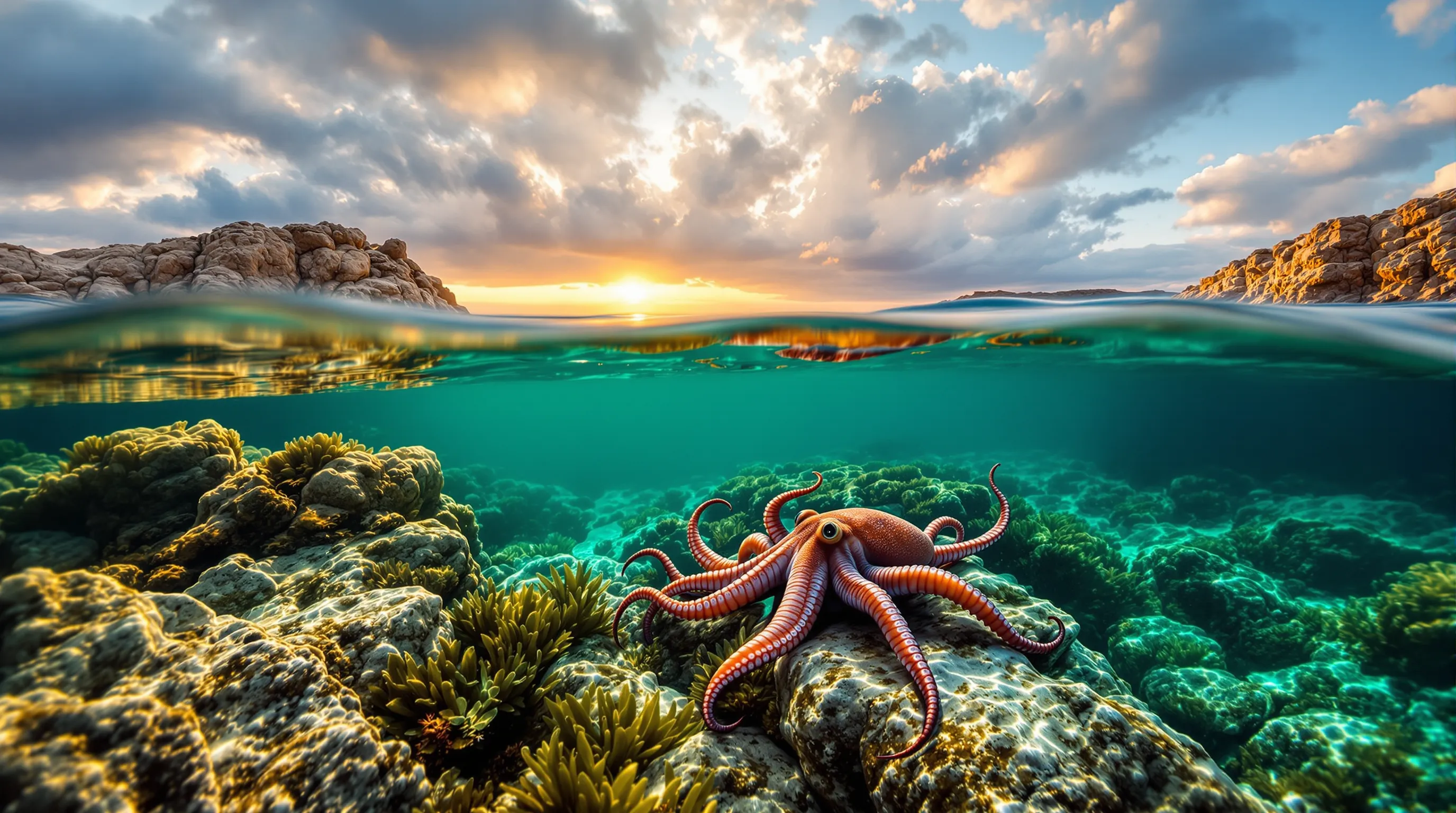
The common octopus has around 500 million neurons, two-thirds of which are distributed across its eight arms, each capable of tasting, touching and reacting almost independently. Researchers at the Endoume marine station in Marseille have spent years studying these cephalopods for their ability to open jars, solve mazes and individually recognise divers. In the Mediterranean, Octopus vulgaris is the most commonly spotted species, alongside the smaller musky octopus (Eledone moschata), recognisable by its single row of suckers and more frequently found on the sandy seabeds of the Languedoc coast. These animals shift texture and colour in a fraction of a second thanks to pigment cells called chromatophores, a feat that helps them both hunt and evade groupers and moray eels, their main predators. Their lifespan is short, rarely exceeding two years, which explains an intense breeding period at the end of summer and a fascinating life cycle for those who know where to look.
Camouflage, their number one weapon
A spotted octopus is an octopus that's failed to hide properly. On the rocky seabeds of the Côte Bleue or Cap Corse, they mimic the texture of seaweed, barnacle-covered rocks or even sand. Experienced divers often spot only their eyes, two small motionless bumps, or the entrance to their den scattered with empty mussel and crab shells, a telltale sign known as a midden, a veritable larder that gives away their presence.
Where to spot them along the French Mediterranean coast
The Marseille calanques, Cassis and La Ciotat are among the best spots, particularly around Île Riou and Calanque de Sormiou, where rocky drop-offs between 3 and 15 metres shelter numerous burrows. Port-Cros National Park, off Hyères, protects a dense population thanks to the fishing ban, offering near-guaranteed encounters while snorkelling around Plage de la Palud. In Corsica, the Scandola and Bonifacio Strait reserves harbour some impressive specimens, occasionally exceeding a metre in span. On the Côte Vermeille, between Banyuls-sur-Mer and Cerbère, the marine nature reserve offers easy access from the beach to observe shallow rocky seabeds from just 2 metres deep. Finally, the Frioul archipelago, a twenty-minute boat ride from Marseille's Vieux-Port, makes for an ideal day trip combining hiking and snorkelling.
Spots you can reach without a boat
You don't need a boat to cross paths with an octopus. Calanque de Sugiton, reachable on foot from Luminy, and Plage de Paloma in Cerbère allow for direct observation from the shore. At low tide early in the morning, shallow rocky areas sometimes reveal octopuses actively hunting, a special window before the arrival of swimmers sends them retreating into their hideouts for the rest of the day.
When to go for the best chances of a sighting
The ideal period runs from June to October, when water temperatures top 18°C and Mediterranean visibility often reaches 15 to 20 metres. September remains naturalists' favourite month: the water is still warm, tourist numbers drop noticeably after 20 August, and the young octopuses born in spring have grown to a clearly visible size. Mornings, between 7am and 10am, offer the best conditions, with calmer seas and more intense hunting activity from these crepuscular creatures. Avoid the hottest hours of the afternoon in July and August, when the octopus retreats into its den to digest and escape the bright light. Winter shouldn't be ruled out for divers kitted out in a thick wetsuit: cooler water makes the animals less skittish, and certain sites such as Port-Cros remain accessible year-round to certified divers, sometimes with visibility even better than in summer.
How to plan your octopus-spotting trip
Snorkelling is more than enough to spot an octopus in coastal waters: mask, snorkel, fins and a light 2-3mm neoprene wetsuit are sufficient for one-to-two-hour sessions without getting too cold. No certification is needed for spots accessible on foot or by free diving from the surface. For scuba enthusiasts wanting to explore the deeper drop-offs of the calanques or Corsica, an Open Water level is generally sufficient, guided by an instructor who knows the usual burrow locations. Always plan an early morning outing to avoid choppy water and crowds, and favour a slow, quiet approach along rock faces rather than swimming in open water. A waterproof camera with a light zoom lets you document the encounter without needing to get too close. Allow half a day for a full outing including travel, getting in the water and observation time, more if you're combining several spots by boat with a local naturalist guide.
Essential kit to bring along
A dive torch, even in broad daylight, helps reveal true colours in dark crevices where natural light doesn't reach. Thin gloves protect against the sea urchins common on Mediterranean rocky seabeds without dulling tactile sensitivity. Avoid anything shiny or reflective that might stress the animal, and opt for neutral colours for your wetsuit, which are less intrusive in the octopus's field of vision.
Practical tips and responsible tourism
Spotting an octopus costs nothing if you head out for independent snorkelling from a public beach; budget a modest amount for a guided free-diving trip, and more for a scuba dive with full kit hired on site, with prices varying according to duration, number of dives and the site's popularity. Book guided outings in advance during peak season, particularly in the national parks of Port-Cros and Scandola, where access quotas are strict to protect the ecosystems. Never touch an octopus: beyond the risk of a bite, the stress caused can lead it to abandon its den or even self-mutilate, a documented defence behaviour in this species. Keep a distance of at least one metre, never use food to lure it out, and avoid scraping at rocks to dislodge it from its hiding place. In areas classified as Natura 2000 sites or nature reserves, foraging and spearfishing are banned or strictly regulated: check with local tourist offices beforehand. Choosing eco-tourism certified operators guarantees a respectful approach to the environment and directly contributes to protecting these fragile populations against overfishing and warming coastal waters.
Frequently asked questions
Is the Mediterranean octopus dangerous to swimmers?
No, the common octopus poses absolutely no danger to humans. It has no harmful venom and shows no aggressive behaviour, systematically trying to flee or camouflage itself when a swimmer approaches. A bite is exceptionally rare and only occurs if the animal feels cornered or is handled directly, something that should always be avoided out of respect for its peace and quiet.
What's the best time of year to see an octopus in the Mediterranean?
From June to October, with a peak in September when the water remains warm, visibility is excellent and tourist numbers are dwindling. Morning outings between 7am and 10am offer the best chances, as octopuses are more active during these hours before retreating into their den during the heat of the day.
Can you spot octopuses without knowing how to dive?
Yes, snorkelling is more than enough at most coastal spots such as Port-Cros or the Côte Vermeille, where octopuses often live between 2 and 8 metres deep. Mask, snorkel and fins allow for comfortable observation from the surface, with no scuba certification required.
How long does an octopus live and where does it breed?
The common octopus rarely lives beyond two years. Breeding mainly takes place at the end of summer and into autumn; the female lays thousands of eggs, which she protects without feeding for several weeks, before dying shortly after they hatch, an intense life cycle characteristic of this species.
Is it legal to fish for octopus in the French Mediterranean?
This depends strictly on the area: spearfishing and foraging are banned in national parks such as Port-Cros and in certain marine nature reserves such as Scandola or Cerbère-Banyuls. Elsewhere, local regulations exist regarding minimum sizes and seasons; always check with the local maritime authorities.
The Mediterranean octopus embodies, all on its own, the quiet richness of our seabeds, combining remarkable intelligence with masterful camouflage. From the Marseille calanques to wild Corsica, every encounter is a reminder of just how much this coastline deserves to be explored with curiosity and respect. To continue this underwater adventure and discover other remarkable encounters with Mediterranean wildlife, including the dolphins that share these same waters, carry on exploring at dauphin-mediterranee.com and start planning your next responsible outing at sea.
Read also

Motorhoming in the Mediterranean: the secret spots regulars never share
Motorhoming on the Mediterranean coast: recommended sites, best seasons and advi...
Mediterranean Coastal Path: 5 Secrets Local Hikers Don't Share
Coastal hiking on the Mediterranean coastal path: routes, best seasons and exper...
What Mediterranean Fishermen Are Doing to Save Fish and Dolphins
Discover responsible fishing in the Mediterranean: protected species, committed ...

Sète and the Thau Lagoon: what the lagoon reveals about the Mediterranean
Discover Sète and the Thau Lagoon: oyster farming, lagoon wildlife, coastal trai...