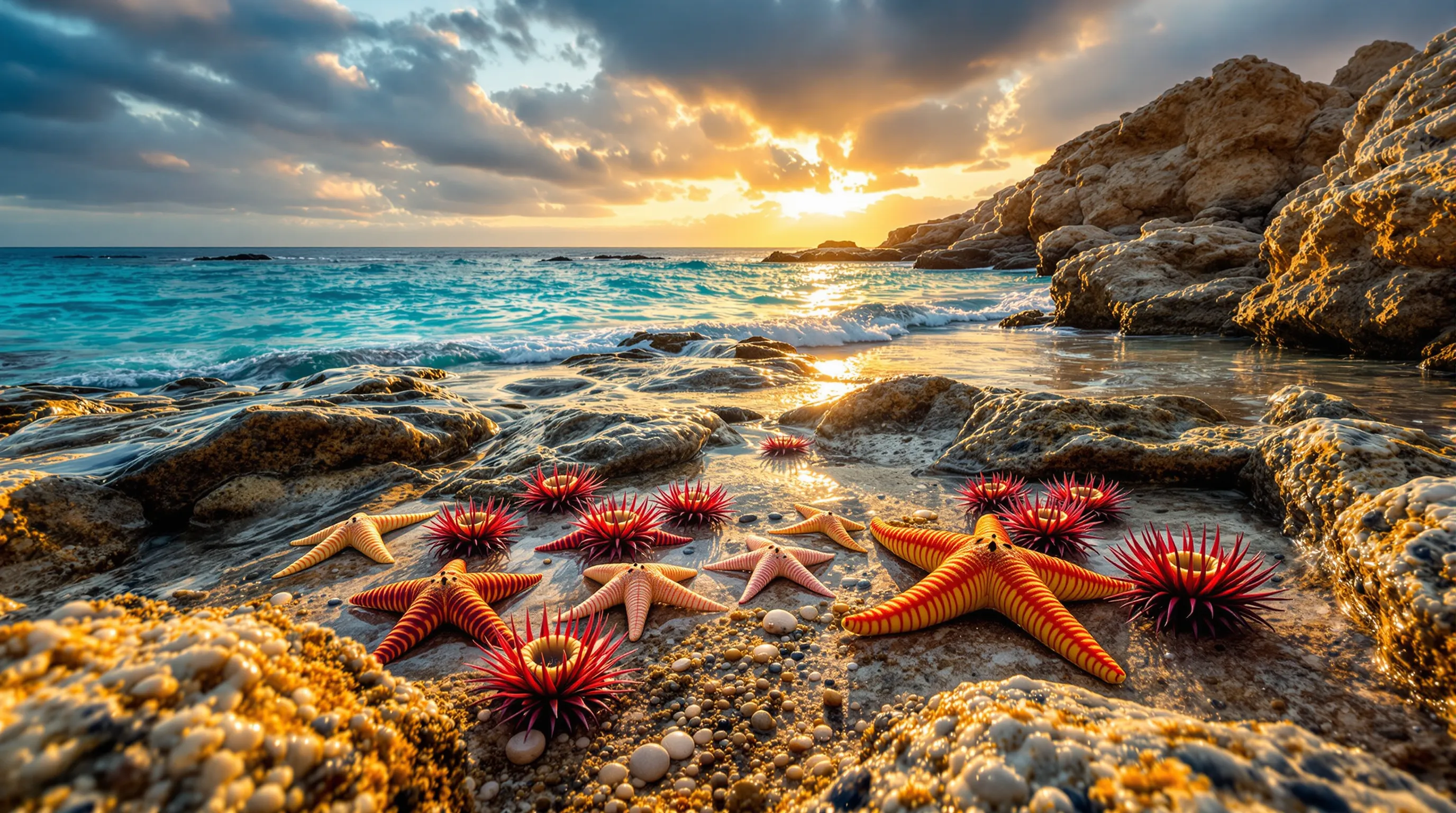
7 Secrets of Mediterranean Starfish That Divers Keep to Themselves
The Mediterranean is home to over 15 species of starfish and 8 varieties of sea urchins, fascinating creatures often overlooked by holidaymakers. These echinoderms play a crucial role in the Mediterranean marine ecosystem, contributing to the balance of rocky and sandy seabeds. The red starfish Echinaster sepositus can live up to 30 years, whilst the purple sea urchin Paracentrotus lividus carves cavities into limestone rocks. Observing them reveals surprising behaviours and remarkable adaptations to Mediterranean marine life, offering divers truly unforgettable encounters.
Iconic Mediterranean Species
The red starfish Echinaster sepositus dominates rocky seabeds between 3 and 200 metres depth. Measuring up to 20 centimetres, it feeds primarily on sponges and bryozoans. The spiny starfish Marthasterias glacialis, recognisable by its sharp spines, can reach 70 centimetres across. Among sea urchins, the purple Paracentrotus lividus colonises coastal rocky zones, creating perfectly circular burrows. The black sea urchin Centrostephanus longispinus, with 4-centimetre black spines, prefers dark caves. These species distribute according to depth, light levels and substrate type, creating the characteristic vertical zonation of Mediterranean coastlines.
Distribution Zones by Depth
Between 0 and 10 metres, purple sea urchins dominate the rocky surfaces. From 10 to 50 metres, red starfish colonise the drop-offs. Beyond 50 metres, deep-water species like spiny starfish take over. This stratification depends on light, temperature and food availability, creating distinct micro-ecosystems.
Fascinating Behaviours and Adaptations
Mediterranean starfish possess extraordinary regenerative abilities: they can regrow a lost arm within 6 to 12 months. Their unique water vascular system allows them to move at 15 centimetres per minute using hundreds of tube feet. Sea urchins use their spines as both defence and locomotion systems, able to rotate each spine individually. Their chewing apparatus, called Aristotle's lantern, crushes algae and detritus with a force of 40 newtons. These creatures communicate through chemical signals, detect vibrations from a distance and navigate using primitive photoreceptors located at the tips of their arms or between their spines.
Ecological Role and Environmental Impact
Starfish regulate populations of sessile invertebrates, maintaining biodiversity within benthic communities. A single Marthasterias can consume 200 grammes of mussels monthly. Purple sea urchins, true gardeners of the rocky seabed, control algal growth and create habitats for other species. Their excavations in limestone rock form micro-reefs sheltering crustaceans and juvenile fish. However, overfishing of natural predators like wrasse and sea bream leads to sea urchin proliferation, causing erosion known as 'marine desertification'. This pressure alters the balance of Posidonia seagrass meadows, a key Mediterranean ecosystem.
Water Quality Indicators
The presence and density of starfish constitute reliable bio-indicators of marine health. Their sensitivity to pollution, thermal variations and acidification reveals the ecological state of coastal zones. Scientists use their populations to monitor climate change impact on Mediterranean ecosystems.
Practical Observation Tips
The best period runs from April to October, with optimal visibility in the morning between 8am and 11am. Focus on rocky areas from 5 to 30 metres depth, particularly drop-offs and boulder fields. Must-visit sites include Port-Cros (Var), Banyuls-sur-Mer (Eastern Pyrenees) and the Marseille calanques. Diving budget: £30-38 per exploration dive, £20-25 with local clubs. Essential kit: minimum 5mm wetsuit, powerful diving torch and underwater camera. Maintain a 50-centimetre observation distance, avoid direct contact and never collect these protected species. PADI or FFESSM certified diving centres offer specialised 'fixed fauna' trips with experienced naturalist guides.
Frequently asked questions
Can you touch starfish and sea urchins in the Mediterranean?
No, it's strictly forbidden to touch or collect these protected species. Human contact disrupts their protective mucus and can transmit deadly bacteria. Observe them from a minimum distance of 50 centimetres to preserve their integrity and comply with French maritime regulations.
At what depth do you find the most starfish in the Mediterranean?
Starfish are most abundant between 10 and 50 metres depth on rocky bottoms. This zone offers stable temperatures of 13-18°C, moderate lighting and abundant food. Beginner divers can spot them from 5 metres in protected areas.
Are Mediterranean sea urchins dangerous for swimmers?
Purple sea urchin spines cause painful but rarely serious injuries. Wear diving boots in rocky areas. If stung, carefully remove spines with tweezers, disinfect and consult a chemist. Black sea urchins are more aggressive but live in deeper waters.
Mediterranean starfish and sea urchins reveal the unexpected richness of our seabeds. Observing them greatly enriches the diving experience, revealing fascinating behaviours and remarkable adaptations. To discover these living treasures during your next Mediterranean holidays, consult our diving guides at dauphin-mediterranee.com and plan your underwater explorations safely.
Read also
What Divers Do in Secret in Villefranche-sur-Mer Waters
Discover the secret water activities of Villefranche-sur-Mer that only locals kn...
What Luxury Yachts Reveal About Monaco's Marine Wildlife
Discover the secrets of wildlife watching from Monaco. Exclusive cruises, Pelago...
What Sea Lovers Truly Discover at Porquerolles
Discover Porquerolles Island, a Mediterranean gem with turquoise waters and pris...
7 Things You Didn't Know About Mediterranean Jellyfish Before Your Holiday
Discover Mediterranean jellyfish: species, invasion periods, first aid and tips ...