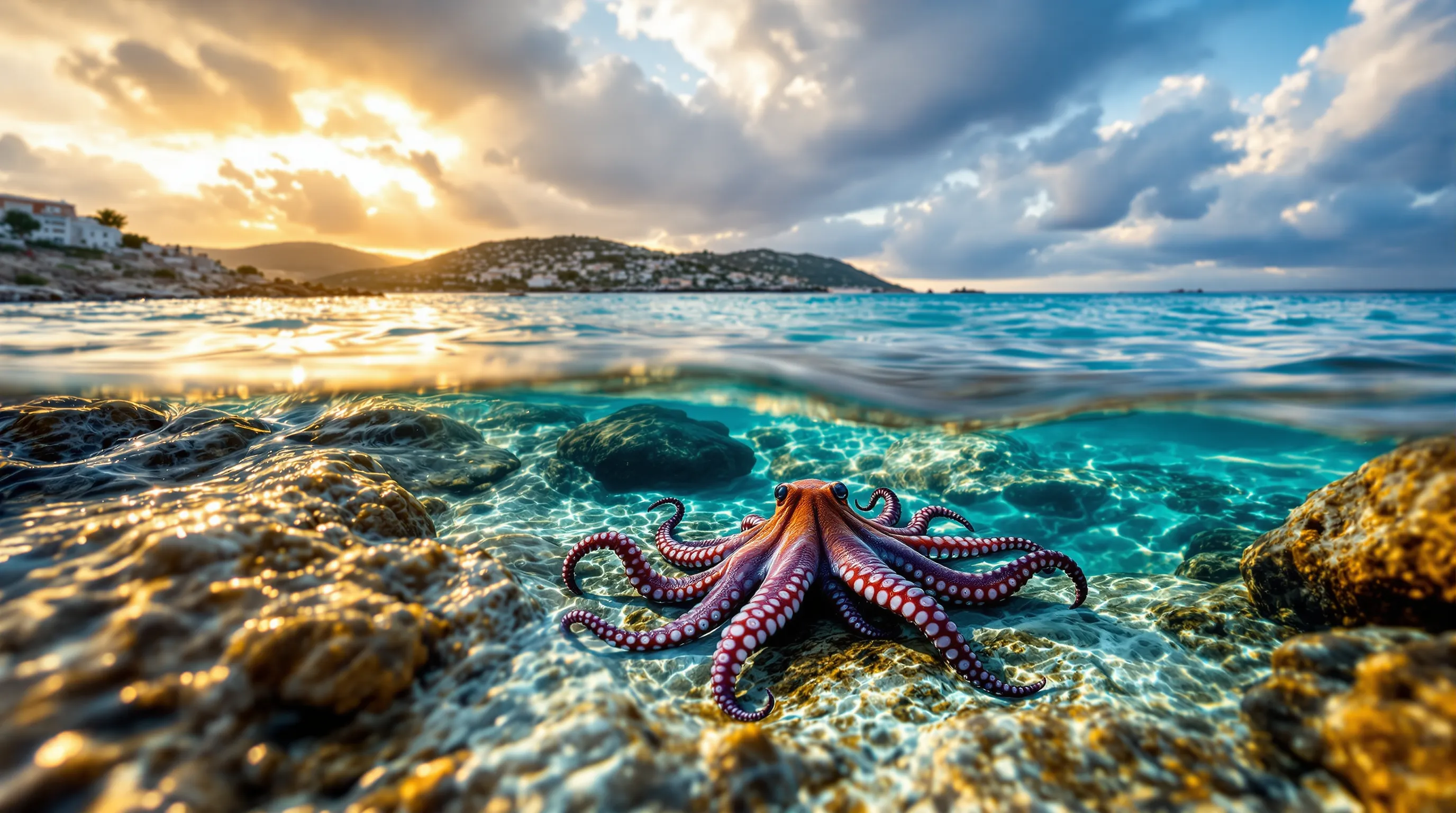
5 Things You Never Knew About the Intelligent Octopuses of the Mediterranean
The crystal-clear waters of the Mediterranean are home to one of the planet's most fascinating invertebrates: the common octopus (Octopus vulgaris). With its 8 muscular arms and 300 suckers per arm, this extraordinary creature inhabits our rocky coastlines from 0 to 200 metres depth. Each summer, over 15 million divers encounter these remarkably capable creatures in Mediterranean waters. From the French Riviera to the Greek islands, these cephalopods reveal behaviours that challenge our understanding of the animal kingdom.
The Surprising Intelligence of Mediterranean Octopuses
The common octopus possesses a brain with 500 million neurons—more than a dog. In Mediterranean waters, scientists have observed remarkable behaviours: tool use, solving complex mazes, and individual recognition of divers. These animals modify their environment by moving stones to create shelters, a phenomenon particularly well-documented in the Calanques near Marseille. Their short-term memory lasts 3 hours, enabling them to memorise hunting routes. Mediterranean octopuses also employ deception: they feign death to escape predators or mimic the colours of dangerous species.
Exceptional Learning Abilities
Octopuses learn through observation and pass on their knowledge. In the Mediterranean, certain individuals have developed hunting techniques specific to their territory, such as opening shells by percussion. This individual intelligence adapts perfectly to the characteristics of each coastal zone, from Posidonia meadows to the rocky drop-offs of the islands.
Masters of Camouflage in the Mediterranean
In less than 0.3 seconds, a Mediterranean octopus completely changes its appearance using chromatophores—pigment cells controlled by its nervous system. This perfect adaptation to Mediterranean sea floors enables them to mimic limestone rocks, brown algae, or fine sand. Their skin also contains iridophores that reflect light, creating striking metallic effects. Octopuses adjust not only their colour but also their texture, reproducing the roughness of rocks or the smoothness of sand. This exceptional ability reaches its peak during mating displays, where males deploy complex striped patterns of white and brown to attract females.
Fascinating Life Cycle in the Mediterranean Environment
Mediterranean octopus reproduction follows a strict annual cycle. Between May and September, during warm water periods (20-26°C), females lay up to 150,000 eggs in rocky crevices. They guard them for 4 to 8 weeks, ceasing to feed until their post-reproductive death. Planktonic larvae drift for 1 to 2 months before settling on coastal bottoms. Growth is rapid: from 2g at birth, they reach 1 to 3kg as adults in 12-18 months. This short lifespan is compensated by intensive reproduction that maintains stable Mediterranean populations despite increasing fishing pressure.
Juvenile Survival Strategies
Young octopuses primarily colonise Posidonia meadows and shallow rocky areas (5-20m) where food is abundant. They consume crustaceans, molluscs, and fish representing up to 30% of their body weight daily. This voraciousness explains their major ecological role in maintaining the balance of Mediterranean coastal ecosystems.
Practical Tips for Observing Octopuses
The best period extends from June to October when water temperature exceeds 18°C. Choose free-diving or scuba diving trips between 8am and 11am, their peak activity period. Rocky sites with crevices (Port-Cros, Calanques, Catalonian coast) offer an 80% chance of sightings. Approach slowly without sudden movements: octopuses flee if disturbed at distances over 2 metres. Average diving trip cost: £30-40 with a club, £70-100 with a private guide. Recommended equipment: minimum 5mm wetsuit, torch to reveal natural colours. Book your trips 48 hours in advance during high season to guarantee your place.
Frequently asked questions
Where can you see octopuses in the French Mediterranean?
The Calanques of Marseille, Port-Cros, L'Estartit, and Banyuls offer the best opportunities. Dive in 5-25 metres on rocky bottoms with cavities. Success rate: 70% in summer, 40% in winter according to local diving centres.
Are Mediterranean octopuses dangerous?
No danger to humans whatsoever. The Mediterranean common octopus measures maximum 60cm with arms extended and weighs 1-3kg. Shy by nature, they flee at the slightest movement. Only precaution: avoid touching them to preserve their protective mucus essential for survival.
What's the difference between octopus and octopi in the Mediterranean?
No biological difference: both terms refer to the same animal (Octopus vulgaris). The correct plural is 'octopuses' in modern English, though 'octopi' is sometimes used. In the Mediterranean, they're universally known as the common octopus regardless of location.
Mediterranean octopuses reveal intelligence and behaviours that fascinate scientists and divers alike. These underwater encounters transform your perception of the animal world and enrich every coastal exploration. To discover other marvels of Mediterranean marine life and organise your observations, consult our expert guides on dauphin-mediterranee.com and prepare for unforgettable dives.
Read also

What Locals Do to Discover Hidden Mediterranean Harbours
Discover secret picturesque harbours along the Mediterranean coast that only loc...

These ancient fishing techniques have preserved the Mediterranean for 3000 years
Discover responsible fishing methods in the Mediterranean that preserve marine e...

What Naturalists Discover on Cruises Departing from Nice
Discover the secrets of naturalist cruises from Nice: dolphin watching, Pelagos ...
10 Secret Mediterranean Snorkelling Spots Only Locals Know About
Discover the 10 best Mediterranean snorkelling spots - hidden gems with crystal-...