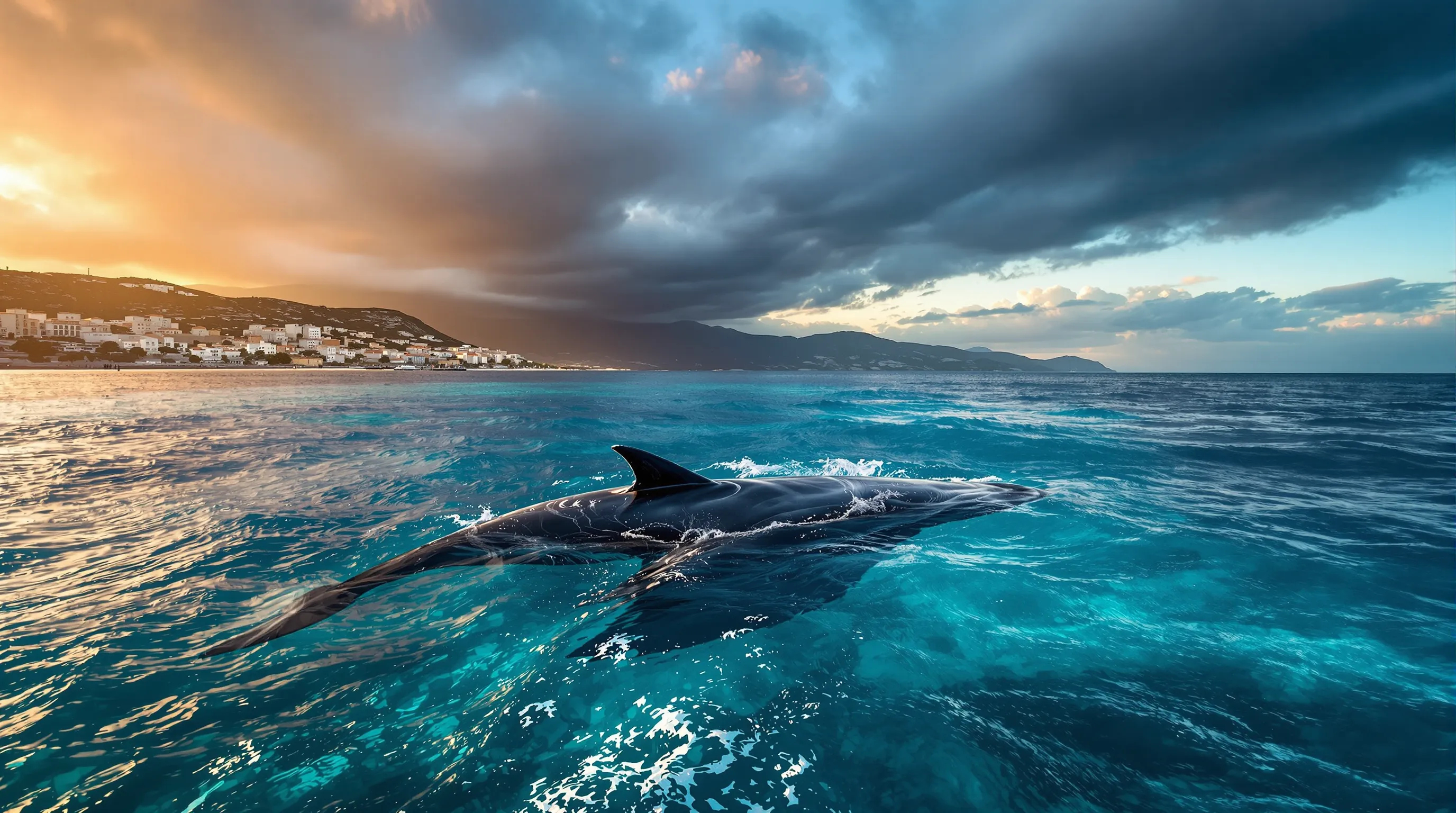
These 18-Metre Giants You Encounter Without Knowing in the Mediterranean
The Mediterranean is home to a resident population of sperm whales estimated at 2,500 individuals, primarily concentrated in the Pelagos International Sanctuary. These ocean giants, reaching up to 18 metres and weighing as much as 50 tonnes, inhabit the deep waters between the French Riviera, Liguria and Sardinia. Contrary to popular belief, they don't migrate and remain year-round in our Mediterranean waters. Observing them represents one of the most extraordinary experiences of coastal tourism, accessible from numerous French, Italian and Monégasque ports.
The Pelagos Sanctuary, kingdom of Mediterranean sperm whales
The Pelagos Sanctuary spans 87,500 km² between France, Italy and Monaco, constituting the favoured zone of Mediterranean sperm whales. This marine protected area benefits from exceptional underwater topography with trenches exceeding 2,000 metres in depth. Sperm whales find their favourite food here: giant squid that rise from the abyss. The northwestern zone, between Antibes and Genoa, boasts the highest density with possible observations 8 months out of 12. Females and their calves favour the warmer southern waters, whilst solitary males frequent the northern zones more often. This geographical distribution directly influences observation strategies and tours offered by tourism operators.
Prime observation hotspots
The Roya Canyon off Nice offers 85% observation chances between May and September. The Calvi Trench in Corsica also presents remarkable success rates of 70% during summer. These particular bathymetric zones concentrate sperm whale prey, guaranteeing memorable encounters for visitors.
Fascinating behaviours of Mediterranean sperm whales
Mediterranean sperm whales display unique behaviours linked to their semi-enclosed environment. Their dives regularly reach 1,200 metres depth for durations of 45 to 90 minutes, records facilitated by the steep gradient of the seabed. At the surface, they spend 8 to 12 minutes breathing, the ideal period for observation. Family groups typically count 8 to 15 individuals, led by an experienced matriarch. Young ones stay close to their mothers for up to 8 years, creating complex social bonds visible during observation trips. Their vocalisations, audible up to 10 kilometres away, serve both for communication and echolocation to locate prey in the Mediterranean depths.
Specificities of the Mediterranean population
Mediterranean sperm whales constitute a genetically distinct population, isolated from their Atlantic counterparts for over 100,000 years. This separation has generated remarkable adaptations: a slightly smaller size (15-16 metres on average versus 18 in the Atlantic) and a diet specialised in endemic Mediterranean cephalopods. Their life expectancy reaches 70 years, with late sexual maturity around 15-20 years. Females give birth every 4 to 6 years after 15 months of gestation. This particular biology makes the population vulnerable, hence the importance of protection measures implemented in the Pelagos Sanctuary and the growing interest in respectful and educational observation tourism.
Threats and conservation in the Mediterranean Sea
Intense maritime traffic represents the main threat with 200,000 annual passages. Ship strikes cause 10% of documented mortality. Noise pollution from military sonar and plastic pollution complete this worrying picture, justifying awareness efforts through observation tourism.
Practical tips for observing sperm whales
The best period extends from May to September with peaks in July-August (90% success rate). Morning departures between 8am and 10am offer the finest conditions: calmer seas and increased sperm whale activity. Allow 4 to 8 hours for excursions from Nice, Antibes, Cannes or Monaco costing £40-75 per adult. Trips from Corsica (Calvi, Ajaccio) last 3-5 hours for £30-55. Book 48 hours in advance during high season. Pack sun cream, a hat, warm clothing and seasickness remedies. Certified operators maintain a 100-metre safety distance and limit observation time to 20 minutes per sperm whale group. Choose providers who are members of the Whale Watching Med network for responsible and scientifically supervised tourism.
Frequently asked questions
Can you see sperm whales year-round in the Mediterranean?
Yes, sperm whales are permanent residents in the Mediterranean. However, the best observation conditions occur from May to September, with success rates of 85% compared to 40% in winter due to challenging weather conditions.
What's the difference between Mediterranean and Atlantic sperm whales?
Mediterranean sperm whales are smaller (15-16m versus 18m), genetically isolated for 100,000 years, and specialised in consuming endemic Mediterranean squid. Their population is stable but limited to approximately 2,500 individuals.
From which French ports can you observe Mediterranean sperm whales?
The main departure ports are Nice, Antibes, Cannes, Monaco and Sanary-sur-Mer. Nice offers the best access to the Roya Canyon, the sperm whales' preferred zone, with 2.5 hours' navigation to reach optimal observation sites.
Observing Mediterranean sperm whales offers a unique experience worldwide, combining geographical proximity with extraordinary encounters with these ocean giants. This eco-responsible activity contributes to their protection whilst raising public awareness of the richness of our marine heritage. To discover other Mediterranean cetacean marvels, explore our dedicated guides on dauphin-mediterranee.com.
Read also

Why 90% of Tourists Overlook These Sustainable Fishing Techniques in the Mediterranean
Discover the secrets of responsible Mediterranean fishing: ancestral techniques,...

Secret Water Activities in Antibes That Locals Keep to Themselves
Discover Antibes' hidden water activities around the peninsula. Secret spots, ex...
How Marine Sanctuaries Are Saving 12,000 Dolphins in the Mediterranean
Discover the marine sanctuaries protecting whales and dolphins in the Mediterran...
7 Fascinating Secrets of Risso's Dolphins Revealed by Marine Biologists
Discover 7 secrets of Risso's dolphins in the Mediterranean revealed by marine b...