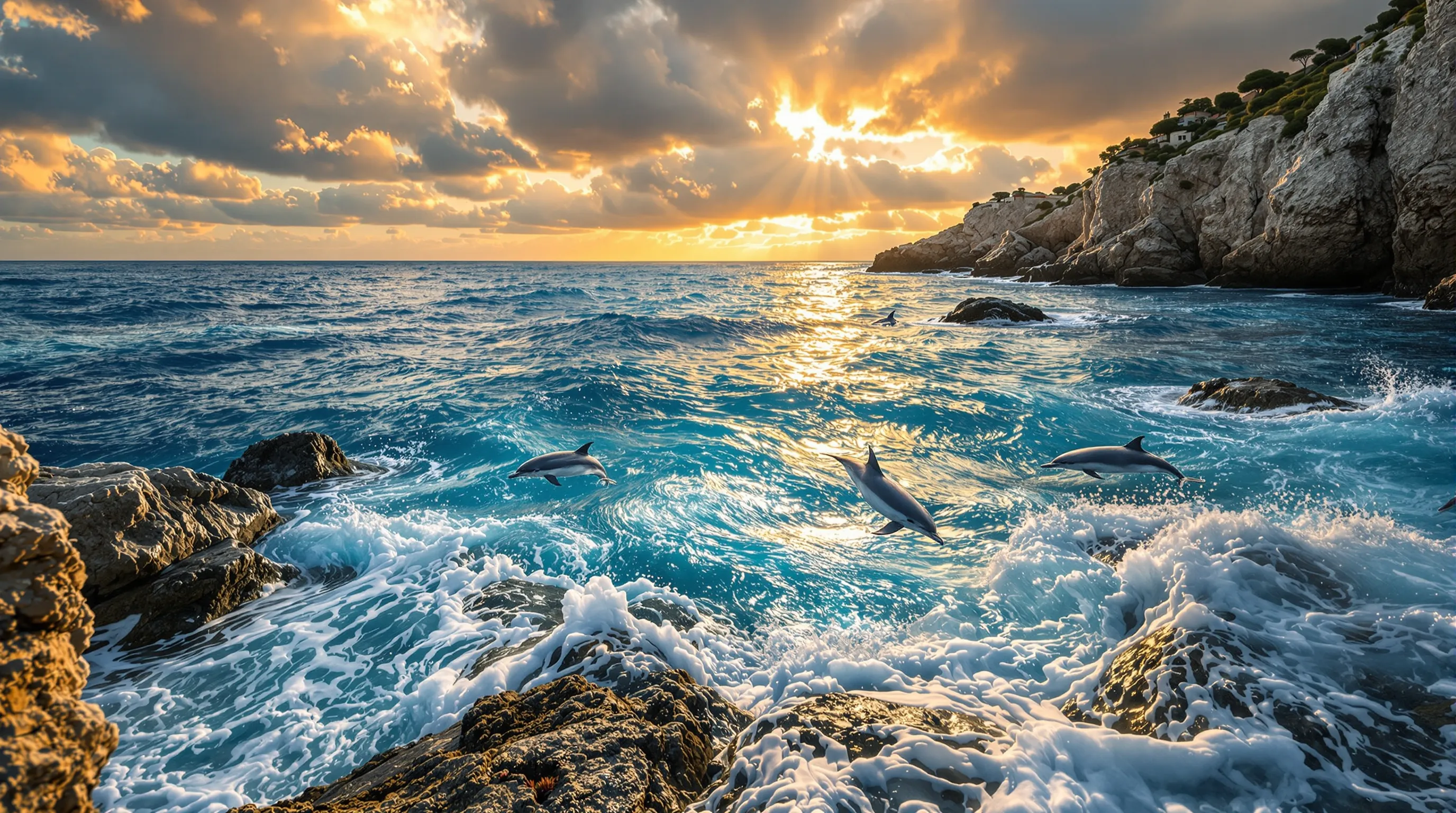
7 Fascinating Secrets of Risso's Dolphins Revealed by Marine Biologists
Risso's dolphin (Grampus griseus) captivates marine biologists with its distinctive appearance and enigmatic behaviour. Reaching up to 4 metres in length, this cetacean stands out with its characteristic bulbous head and white scars that tell the story of its life. In the Mediterranean, approximately 2,500 individuals inhabit the deep waters, particularly between the French Riviera and Liguria. These marine mammals favour areas where depths exceed 400 metres, primarily hunting squid during dives reaching 500 metres deep.
Portrait of Risso's Dolphin in the Mediterranean
Risso's dolphin displays unique characteristics that make it easily recognisable. Its robust body, measuring between 2.6 and 4 metres, sports a dark grey colouration that lightens with age. The white scars, caused by interactions with their peers and squid, create a unique pattern on each individual, serving as a natural identity card for researchers. Its bulbous head, lacking a pronounced rostrum, houses a developed melon used for echolocation. In the Mediterranean, these dolphins form groups of 10 to 30 individuals, primarily inhabiting the Pelagos Sanctuary, a protected marine area spanning 87,500 km² between France, Italy, and Monaco.
Adaptation to Mediterranean Waters
Mediterranean Risso's dolphins have developed specific adaptations to this semi-enclosed environment. Their diet consists of 90% squid, notably Histioteuthis bonnellii, abundant in submarine canyons. This dietary specialisation explains their preference for deep waters where temperatures range between 13 and 15°C, ideal conditions for their favourite prey.
Fascinating Behaviours and Life Habits
Risso's dolphins exhibit complex social behaviours that intrigue scientists. Unlike other species, they rarely perform spectacular leaps, preferring more discreet movements at the surface. Their dives average 15 minutes, with records reaching 30 minutes at 500 metres depth. Females give birth after 13 to 14 months' gestation, typically in summer, and nurse their calves for 15 to 18 months. Lifespan can reach 35 years. Their communication system relies on highly specialised echolocation clicks, adapted for nocturnal hunting of cephalopods. Groups often adopt a line formation during movements, optimising their collective hunting efficiency in Mediterranean deep waters.
Prime Observation Areas in the Mediterranean
The Pelagos Sanctuary constitutes the primary hotspot for observing Risso's dolphins, with maximum concentration between Nice and Genoa. The canyons of Roya, Var, and Monaco offer ideal conditions, with depths rapidly reaching 2,000 metres. The optimal period extends from May to September, when weather conditions permit regular sea excursions. Observations typically occur between 8am and 4pm, when dolphins surface after their nocturnal hunts. Sanremo, Antibes, and Monaco offer specialised excursions with experienced naturalist guides. Observation success rates vary between 60% in May-June and 85% in July-August, depending on weather conditions and prey presence.
Best Land-Based Observation Spots
Certain coastal observation points allow glimpses of Risso's dolphins. Cap d'Antibes, Pointe de la Garoupe, and Monaco's cliffs offer unobstructed views over deep waters. Equip yourself with 10x42 binoculars minimum and favour calm mornings. Telltale signs include surface disturbances and flocks of seabirds.
Practical Tips for Successful Observation
An observation trip costs between £40 and £55 for adults, with family discounts frequently offered. Book 48 hours in advance during peak season to guarantee your place. Boats typically depart around 9am for 3 to 4-hour excursions. Choose operators certified by High Quality Whale-Watching, ensuring compliance with cetacean approach guidelines. Bring sun cream, hat, windproof jacket, and camera with telephoto lens. Optimal weather conditions include winds below 15 knots and calm to slightly choppy seas. September and October offer the best compromise between pleasant weather and high observation probability, with less tourist crowds than midsummer.
Frequently asked questions
What's the best time to observe Risso's dolphins in the Mediterranean?
The optimal period runs from May to September, with peak observations in July-August. September offers the best compromise between favourable weather conditions, high observation probability (75%), and fewer tourist crowds. Morning trips between 9am and noon present the best chances of success.
How can you distinguish a Risso's dolphin from other Mediterranean species?
Risso's dolphin is distinguished by its bulbous head without a marked rostrum, large size (3-4m), dark grey colour peppered with white scars, and discreet surface behaviour. Unlike striped dolphins, it rarely performs spectacular leaps and prefers very deep waters.
Where can I book a Risso's dolphin watching excursion from the French Riviera?
The ports of Nice, Antibes, Cannes, and Monaco offer specialised excursions with certified operators. Expect £40-55 per adult for 3-4 hour trips. Book through official websites or directly at marinas. Choose operators certified by High Quality Whale-Watching for responsible tourism.
Risso's dolphin reveals all its secrets to patient observers who venture into Mediterranean deep waters. This fascinating species deserves our respect and protection to preserve the richness of our marine heritage. Discover more wonders of Mediterranean cetaceans and plan your next encounter with these ocean giants.
Read also

Why These 7 Mediterranean Ports Will Transform Your Coastal Travel Experience
Discover the most authentic picturesque harbours along the Mediterranean coastli...
7 fascinating facts about sperm whales you'll discover in the Mediterranean
Discover the secrets of Mediterranean sperm whales: migrations, unique behaviour...

These Mediterranean Marine Creatures Hide Extraordinary Secrets
Discover fascinating Mediterranean starfish and sea urchins: species, habitats, ...

What the Pros Actually Do to Nail Underwater Photography in the Mediterranean
Discover the secret techniques professional photographers use to capture Mediter...