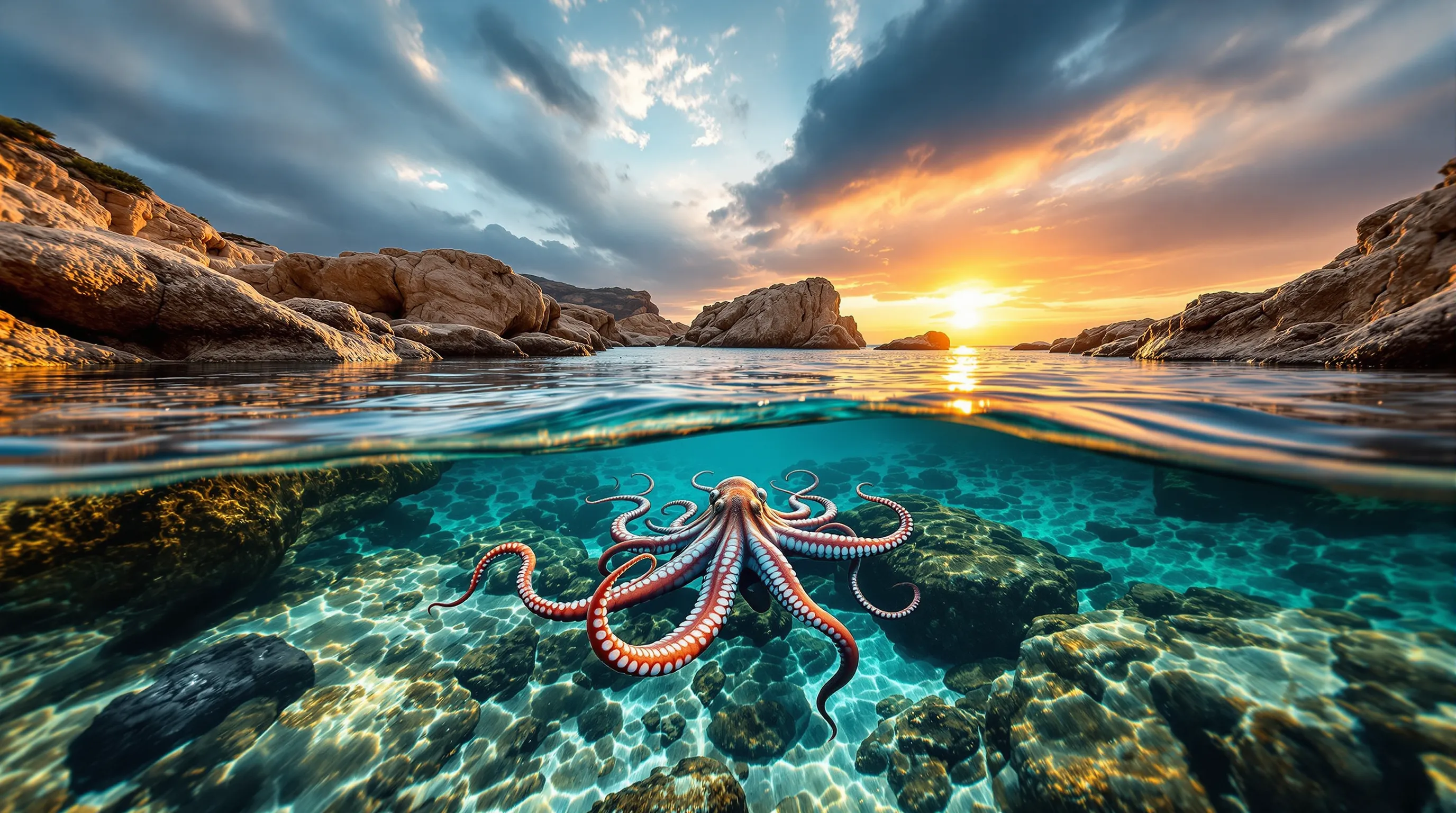
7 secrets of Mediterranean octopuses that even marine biologists don't know
The crystal-clear waters of the Mediterranean harbour one of our planet's most fascinating creatures: the common octopus (Octopus vulgaris). With eight arms equipped with 300 suckers each and a complex brain containing 500 million neurons, this invertebrate challenges our understanding of animal intelligence. Present throughout the Mediterranean coastline, from the French Riviera to the Greek shores, the Mediterranean octopus reveals extraordinary capabilities that science continues to discover today. These masters of camouflage instantly transform their appearance, solving complex puzzles whilst orchestrating hunting strategies worthy of the ocean's greatest predators.
The extraordinary intelligence of Mediterranean octopuses
Mediterranean octopuses possess a unique decentralised nervous system: 60% of their neurons are located in their arms, allowing them to process information autonomously. This neurological architecture explains why a severed arm continues to respond to stimuli for several hours. In the Mediterranean, marine biologists have documented complex behaviours such as tool use: octopuses collect shells to build mobile shelters, stack stones to create protective gardens around their dens. Their short-term memory surpasses that of many vertebrates, retaining information for several weeks. Specimens observed off the coasts of the Côte d'Azur and Provence demonstrate remarkable learning abilities, solving mazes in fewer than five attempts.
Unique decentralised nervous system
Unlike humans, octopuses process information simultaneously across eight distinct nerve centres. Each arm functions as an autonomous mini-brain, capable of tasting, touching and even making independent decisions. This architecture enables Mediterranean octopuses to coordinate complex movements whilst monitoring their environment through 360 degrees, a crucial advantage in the often murky coastal waters.
Masters of camouflage: survival techniques in the Mediterranean
The camouflage abilities of Mediterranean octopuses surpass the most advanced military technologies. Their skin contains three types of specialised cells: chromatophores (coloured pigments), iridophores (metallic reflections) and leucophores (brilliant white). Within 0.3 seconds, they perfectly mimic the texture and colour of limestone rocks, brown algae or Mediterranean sand. Coastal populations along the French Riviera have developed specific patterns mimicking Posidonia seagrass formations, whilst those around the Balearics reproduce the hues of red coral. This chromatic adaptation is accompanied by textural modifications: their smooth skin becomes rough like a rock or undulated like seaweed. Divers regularly report octopuses remaining completely invisible at less than a metre's distance.
Secret habitats and preferred breeding zones
Mediterranean octopuses establish their territories between 5 and 200 metres depth, favouring rocky areas rich in hiding spots. The Calanques near Marseille, Corsican underwater caves and the rocky debris fields of the Cinque Terre constitute their preferred habitats. Each individual occupies a territory of 50 to 100 square metres, marked by accumulations of empty shells - veritable 'rubbish heaps' revealing their presence. Reproduction intensifies from April to June in temperate waters (18-22°C). Females lay up to 500,000 eggs in rocky crevices, guarding them jealously for 4 to 8 weeks depending on temperature. This critical period determines the species' reproductive success in the Mediterranean.
Mediterranean breeding sanctuaries
Marine protected areas such as Port-Cros, Scandola and Cabrera offer optimal breeding conditions. These preserved zones maintain stable octopus populations, with densities reaching 2 to 3 individuals per 100m². Fishing restrictions allow females to complete their reproductive cycle without human disturbance.
Practical tips for observing octopuses in the Mediterranean
Observing Mediterranean octopuses requires patience and technique. The best periods extend from May to September, with activity peaks at twilight (6-8pm). Estimated budget: mask and snorkel (£20-35), wetsuit (£70-130), or guided diving excursions (£40-55). Must-visit spots include the Cerbère-Banyuls Reserve, the Îles d'Hyères, Corsica's Scandola Reserve and the crystal-clear waters around Zakynthos in Greece. Observation techniques: slow approach, fluid movements, avoiding sudden gestures. Curious octopuses sometimes approach motionless divers. Maintain a safe distance (2-3 metres) and never touch or harass the animal. Advance booking (15-30 days) is recommended for guided excursions during peak season, particularly in protected marine parks where visitor quotas are limited.
Frequently asked questions
Where can you see octopuses along the French Mediterranean coast?
The best spots include the Marseille Calanques, Port-Cros, the Cerbère-Banyuls reserve and the Îles d'Hyères. Focus on rocky areas between 5-30m depth, particularly active at twilight. Local diving centres offer specialised excursions from May to September.
Are Mediterranean octopuses dangerous to humans?
No, Mediterranean octopuses (Octopus vulgaris) are completely harmless to humans. Naturally timid, they flee at the slightest sudden movement. Their bite, which is extremely rare, is not venomous unlike some Australian species. Simply maintain an observation distance of 2-3 metres to avoid causing stress to the animal.
What's the best season for observing octopuses in the Mediterranean?
The optimal period runs from May to September with peaks in June-July. Water temperatures reach 20-25°C, encouraging octopus activity. Sightings are most frequent at twilight (6-8pm) and dawn. Avoid winter when they retreat to deeper waters and are less active.
Mediterranean octopuses remind us that our seas still harbour countless mysteries. These extraordinary creatures, true geniuses of the depths, deserve our respect and protection. To discover other marvels of Mediterranean marine life and plan your next underwater adventures, explore the comprehensive resources at dauphin-mediterranee.com. Together, let's preserve these living treasures for future generations.
Read also
What Marseille Locals Keep Secret About Their Favourite Water Activities
Discover Marseille locals' secret sea activities: diving, sailing, paddleboardin...
What Mediterranean Posidonia Seagrass Meadows Hide Beneath the Waves Will Amaze You
Discover the secrets of posidonia seagrass meadows, the true lungs of the Medite...
Why the Calanques of Marseille Hide the Mediterranean's Most Beautiful Diving Sites
Discover the secrets of diving in Marseille's Calanques: exceptional sites, Medi...
These Mediterranean corals survive heatwaves and revolutionise marine ecology
Discover how Mediterranean corals defy climate change and transform our coastlin...