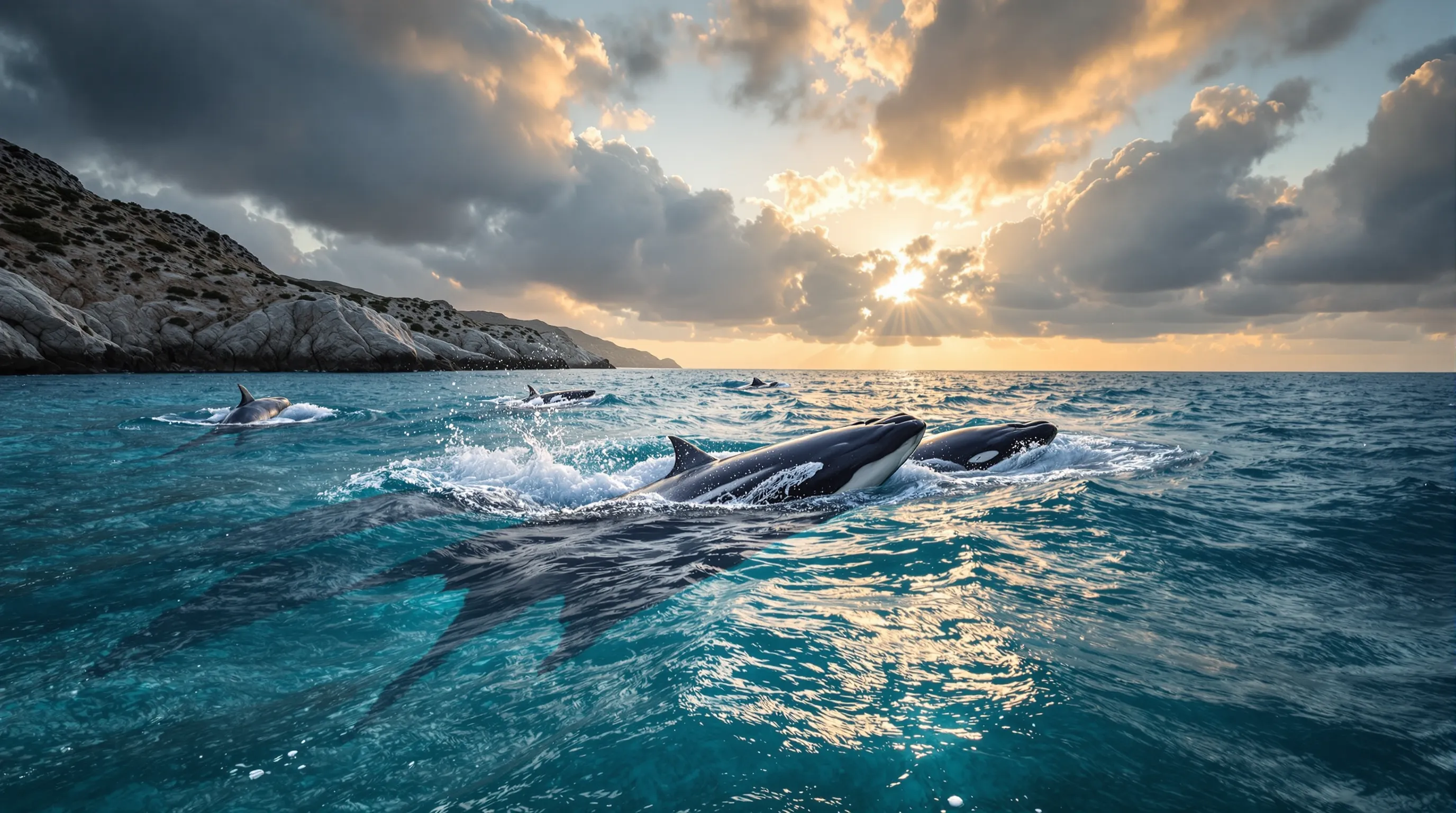
5 secrets marine biologists keep about long-finned pilot whales
Long-finned pilot whales (Globicephala melas) represent one of the most fascinating cetacean species in the Mediterranean. These marine mammals, measuring 4 to 6 metres in length, traverse our waters in family pods that can number up to 50 individuals. Unlike dolphins, they dive to depths of up to 500 metres to hunt squid. Their presence in the western Mediterranean, particularly off the French and Spanish coasts, offers exceptional viewing opportunities. These little-known giants conceal complex social behaviours and remarkable adaptive abilities that continue to surprise researchers today.
Portrait of an unsung Mediterranean giant
The long-finned pilot whale is distinguished by its characteristic bulbous head and uniform dark colouring. Weighing between 1.5 and 3 tonnes, it measures an average of 5 metres for females and 6 metres for males. Their exceptional longevity can reach 60 years. These cetaceans live in matriarchal structures led by the eldest female. Their brain, proportionally more developed than that of bottlenose dolphins, grants them remarkable cognitive abilities. Pilot whales communicate through complex whistles and develop dialects specific to each family group. In the Mediterranean, populations are primarily concentrated in the deep waters of the Ligurian-Provençal basin, where oceanographic conditions favour an abundance of their favourite prey.
Anatomy adapted to great depths
Their morphology reveals unique adaptations: elongated pectoral fins for better manoeuvrability, developed lung capacity enabling 16-minute breath holds, and an optimised circulatory system to withstand extreme pressures. Their relatively small eyes compensate with an ultra-high-performance echolocation system in the darkness of marine depths.
Extraordinary social behaviours observed in the Mediterranean
Long-finned pilot whales exhibit one of the most complex social organisations in the marine animal kingdom. Family groups, called pods, maintain bonds across multiple generations. Adult males temporarily leave the group for reproduction but return afterwards. Females share the rearing of young in a remarkable system of mutual support. In the Mediterranean, observations reveal coordinated hunting behaviours: adults encircle squid schools whilst others dive to capture them. These collective hunting strategies require sophisticated communication and perfect coordination. Researchers have documented play sequences between young individuals, learning behaviours passed from generation to generation, and even mourning rituals when a group member disappears.
Prime viewing areas in the western Mediterranean
The Pelagos Sanctuary, between France, Monaco and Italy, constitutes the primary hotspot for observing long-finned pilot whales. This protected marine area of 87,500 km² accounts for 38% of annual sightings. The Spanish Catalonian coasts, particularly off Tarragona and Barcelona, also offer excellent opportunities between April and October. The submarine canyons of the French Riviera, particularly Monaco's canyon, regularly attract these cetaceans thanks to the abundance of cephalopods. Whale watching professionals report a 65% observation success rate in these areas between May and September. Ideal weather conditions include calm seas with visibility exceeding 10 kilometres and winds below 15 knots.
Best period for observation
The optimal season extends from May to October, with peak activity in July-August. Pilot whales follow the migrations of squid, their primary prey. Morning excursions between 8am and 11am offer the best viewing conditions, as these cetaceans then surface after their nocturnal deep-water hunts.
Practical tips for successful observation
A whale watching trip costs between £40-75 per person depending on duration and chosen operator. Four-hour excursions from Nice, Cannes or Monaco offer the best value for money. Book 48 hours in advance during peak season and check weather forecasts. Equip yourself with polarised sunglasses, SPF 50 sun cream, warm clothing for the open sea and 8x42 minimum binoculars. Rigid inflatable boats allow for more respectful approaches and closer observations. Choose operators certified under High Quality Whale Watching schemes that respect cetacean approach guidelines: minimum 100-metre distance, reduced speed, limited observation time. Patience remains essential as these wild animals guarantee no encounters, despite favourable statistics from prime locations.
Frequently asked questions
What's the difference between long-finned pilot whales and dolphins in the Mediterranean?
Long-finned pilot whales are much larger (4-6m versus 2-3m), have a distinctive bulbous head, uniformly dark colouring, and live in more stable family groups. They also dive much deeper (500m versus 150m maximum for dolphins).
Can you swim with long-finned pilot whales in the Mediterranean?
Swimming with pilot whales is strictly prohibited in France and the Pelagos Sanctuary for their protection. These wild animals can be stressed by human presence. Observation from boats whilst respecting regulatory distances remains the only authorised and respectful approach.
Where can you spot long-finned pilot whales from shore without a boat?
Shore-based observation remains very rare as they generally operate offshore. Elevated headlands such as Cap d'Antibes, Cap Ferrat or the Corniche des Maures occasionally offer distant glimpses with good binoculars, but boat trips remain essential for proper observation.
Long-finned pilot whales enrich Mediterranean biodiversity through their majestic presence and fascinating behaviours. Their responsible observation contributes to awareness and protection of these unsung giants. Discover other Mediterranean cetacean wonders and plan your next whale watching excursion on dauphin-mediterranee.com for an unforgettable experience in the heart of the Pelagos Sanctuary.
Read also

7 secrets about fin whales that marine biologists finally reveal
Discover the 7 fascinating secrets of Mediterranean fin whales revealed by marin...

How Wildlife Cruises from Nice Reveal Hidden Mediterranean Treasures
Discover the secrets of wildlife cruises from Nice: dolphins, whales and the Pel...

7 secrets captains reveal for whale watching in the Mediterranean
Discover where and when to spot whales in the Mediterranean with exclusive tips ...
5 Secret Cruises Locals Keep to Themselves on the French Riviera
Discover 5 confidential cruises on the French Riviera that only insiders know ab...