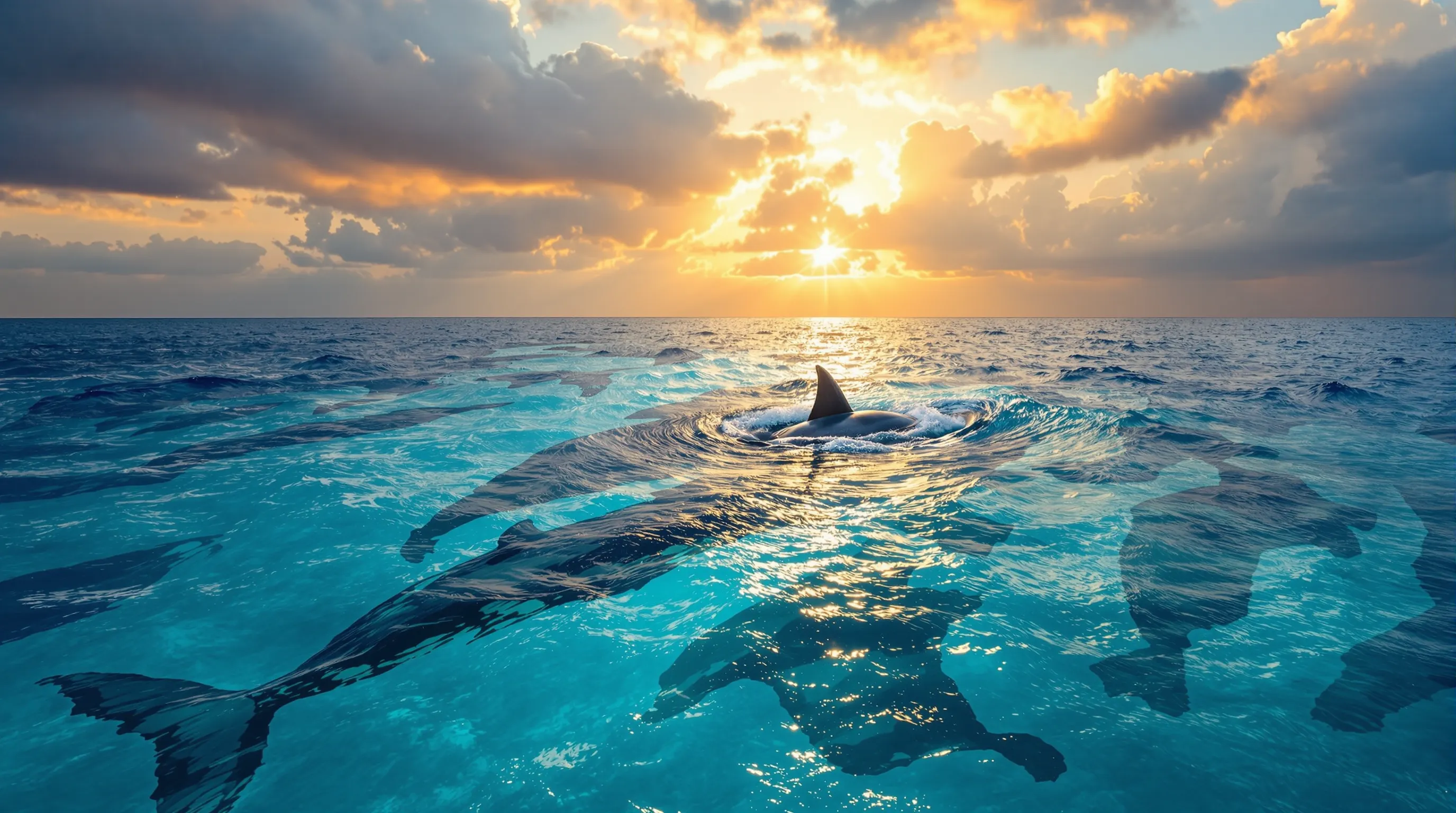
7 secrets about fin whales that will transform your view of the oceans
The fin whale reigns supreme over Mediterranean waters as the second largest animal on the planet. Measuring up to 24 metres and weighing 70 tonnes, this giant traverses the Pelagos Sanctuary between France, Monaco and Italy each summer. Contrary to popular belief, the Mediterranean hosts a resident population of 3,500 individuals that feed on the abundant krill in these nutrient-rich waters. Their presence transforms our understanding of this exceptional marine ecosystem, offering visitors unforgettable encounters with one of the ocean's most impressive predators.
Master of Mediterranean waters: anatomy of a giant
The fin whale stands out with its streamlined silhouette and exceptional speed of 40 km/h, earning it the nickname 'greyhound of the seas'. Its asymmetrical head, unique amongst mammals, features a white right jaw and dark grey left jaw. This anatomical peculiarity optimises its spiral hunting technique. Its 700 baleen plates filter up to 2,000 kg of krill and small fish daily. In the Mediterranean, these giants reach a slightly smaller size than their Atlantic cousins, but compensate with remarkable agility in these warmer, shallower waters compared to polar oceans.
Physical records and performance
A Mediterranean fin whale develops a cardiac output of 400 litres per heartbeat and can hold its breath for 20 minutes. Its dives reach depths of 500 metres, exploiting underwater canyons rich in prey. Its dorsal fin, positioned two-thirds along the body, measures up to 60 centimetres and enables individual identification through unique scars and notches.
Pelagos Sanctuary: the giants' motorway
The triangle formed by the French Riviera, Italian Riviera and Corsica accounts for 40% of fin whale sightings in the Mediterranean. This 87,500 km² area benefits from upwellings created by mistral winds, bringing nutrients up from the depths. The Monaco Canyon, reaching 2,700 metres deep, generates a unique ecosystem where euphausiids and copepods thrive - the fin whale's favourite food. Ligurian-Provençal currents create thermal fronts rich in plankton, transforming this region into a veritable giant restaurant. Between June and October, up to 150 individuals simultaneously frequent these exceptional waters, providing optimal viewing conditions.
Behaviour and social life of solitary giants
Unlike gregarious sperm whales, fin whales prefer solitude, only gathering in exceptional feeding areas. Their low-frequency 20 Hz song, inaudible to human ears, carries 100 kilometres underwater. These complex vocalisations facilitate communication between dispersed individuals and may play a role in reproduction. In the Mediterranean, females give birth every 2-3 years to a 6-metre calf weighing 2 tonnes. Maternal nursing lasts 6-7 months, during which the youngster consumes 500 litres of fat-rich milk daily to double its size.
Migration and territorial fidelity
Mediterranean fin whales undertake shorter migrations compared to their oceanic counterparts. They overwinter in the Algerian-Provençal basin and move northward to Pelagos in spring. Some individuals show remarkable fidelity to the same feeding areas, returning year after year to favourite underwater canyons, facilitating their study and identification by scientists.
Practical tips for spotting fin whales
The best period runs from May to October, with peak activity in July-August. Trips from Nice, Cannes, Monaco or Imperia cost £30-55 per adult for 3-4 hours at sea. Choose operators certified with 'High Quality Whale Watching' guaranteeing respect for approach distances (100 metres minimum). Optimal conditions require calm seas (swell <1m) and visibility >5 nautical miles. Embark early morning (8am-9am) when winds are light. Bring sun protection, warm clothing and seasickness remedies. Success rates reach 85% during peak season in the Pelagos Sanctuary, with sustained observations lasting 15-45 minutes per encounter.
Frequently asked questions
What's the best season for spotting fin whales in the Mediterranean?
The optimal period runs from June to September, with a peak in July-August. This is when fin whales concentrate in the Pelagos Sanctuary to feed on abundant krill. Weather conditions are also more favourable with calm seas and excellent visibility for observations.
How much does a fin whale watching trip cost from the French Riviera?
Prices range from £30 to £55 per adult for a 3-4 hour trip. Costs depend on boat size, included services and operator reputation. Expect £20-35 for children and discounts for family groups or advance bookings.
How close can you get to fin whales during Mediterranean observations?
Regulations require a minimum distance of 100 metres from fin whales. Certified operators strictly follow these rules to protect the animals. However, curious whales sometimes approach boats spontaneously, providing spectacular observations whilst respecting their welfare.
The fin whale transforms every Mediterranean sea trip into an extraordinary adventure. These 70-tonne giants remind us of the unsuspected richness of our coastline. To experience this unique encounter with the second largest animal on the planet, discover our excursion recommendations and observation tips on dauphin-mediterranee.com. The thrill of spotting that distinctive spout on the horizon will forever change your view of the Mediterranean.
Read also
7 Secrets Hidden in the Mediterranean's Most Picturesque Harbours
Discover the most authentic Mediterranean harbours and their untold stories. Com...
These 7 dolphin behaviours will amaze you on your trip out
Discover where and when to watch dolphins in the Mediterranean. Complete guide w...
5 fascinating secrets about common dolphins revealed by scientists
Discover 5 extraordinary secrets of Mediterranean common dolphins revealed by th...

Why Posidonia Seagrass Meadows Save Our Mediterranean Sea Every Day
Discover how Posidonia seagrass meadows purify the Mediterranean, protect coastl...