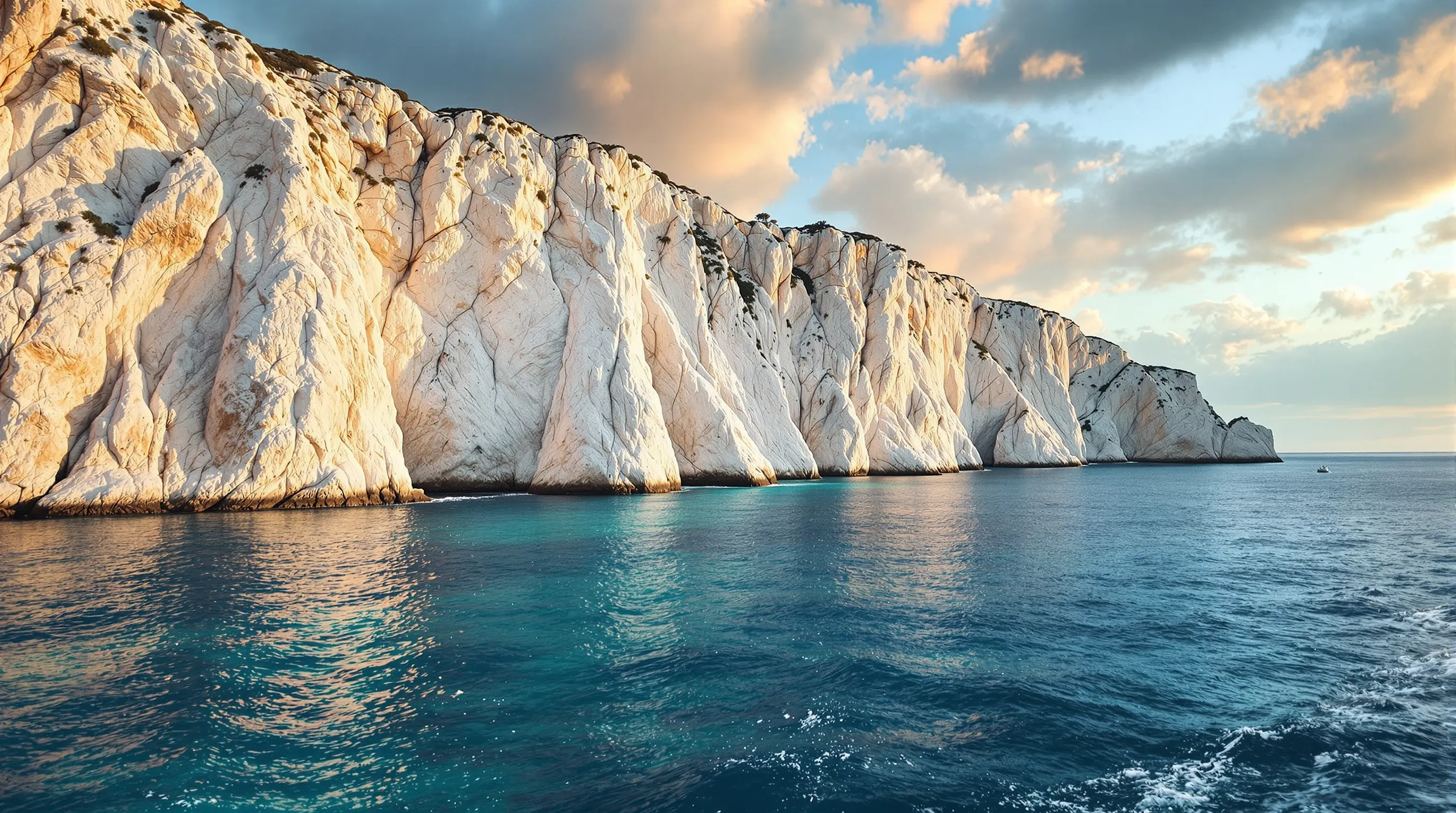
Bonifacio seen from the sea: what these white cliffs tell visitors
The first time I skirted the cliffs of Bonifacio in a rigid inflatable, a pair of Scopoli's shearwaters skimmed the hull before diving beneath a wave. That day, I understood why this southern tip of Corsica captivates biologists and holidaymakers alike. The white limestone, carved by wind and sea over millennia, plunges sheer into water of an almost unreal blue. Seen from a boat, the citadel perched 70 metres up becomes tiny against the vastness of the Strait of Bonifacio, a protected nature reserve where loggerhead turtles, dolphins and occasionally sperm whales cross paths. A boat trip here isn't just a pleasant outing: it's a plunge into a rare ecosystem.
Cliffs shaped by sea and wind
The cliffs of Bonifacio rise to around 70 metres and stretch for several kilometres between Pointe de Pertusato and the Paragan cove. This soft limestone, laid down almost 20 million years ago, erodes differently depending on the rock layers: wind hollows out alcoves, while the swell undermines the base and causes regular collapses, visible to the naked eye on some recent sections. From a boat, you can clearly make out the contrast between the brilliant white limestone and the dark green maquis clinging to the clifftop. The sea caves, such as the Sdragonato Cave with its Corsica-shaped opening, can only be visited by small, shallow-draught boats, and only when the sea is calm. The site is designated Natura 2000 and forms part of the Strait of Bonifacio, one of the richest marine areas in the western Mediterranean, home to red coral, groupers and colonies of seabirds such as the Audouin's gull, a rare protected species that nests on the nearby Lavezzi and Cerbicale islets.
The Sdragonato Cave and marine cavities
Accessible only by sea, this cave takes its name from the fissure in its roof, which evokes the outline of Corsica in a play of light on the turquoise water below. Local boat operators bring visitors here late morning, when the sun is at its zenith, to make the most of this striking light effect. The visit rarely lasts more than ten minutes, just long enough for the boat to manoeuvre carefully between the rock walls. These cavities are also home to bat colonies and darkness-adapted benthic fauna, both fragile and best left undisturbed by flash photography or noise.
Where to set off: ports and spots around Bonifacio
Most departures leave directly from Bonifacio harbour, below the old town, where several local operators run half-day trips along the cliffs and out to the Lavezzi Islands. These islands, a designated nature reserve, are reached in 30 to 45 minutes by boat and offer crystal-clear waters perfect for snorkelling around pink granite, a striking contrast to the limestone of Bonifacio. For a wilder experience, some licence-free motorboat hire firms (up to 6hp) let you hug the coast from Piantarella beach, a handy starting point for the Lavezzi Islands. Sea kayaking enthusiasts often set off from Sutta Rocca beach or the harbour itself, for a slower, quieter approach to coves inaccessible on foot, such as Paragan cove. The Strait of Bonifacio, the channel between Corsica and Sardinia, concentrates exceptional biodiversity: it's also a regular migration corridor for common dolphins and, in late summer, occasionally fin whales, making it a route closely monitored by cetacean research organisations.
The Lavezzi Islands, a natural extension of the trip
This granite archipelago, a nature reserve since 1982, can only be visited by boat and has regulated landing rules to protect the endemic flora and the turtles that sometimes nest there. The water is exceptionally clear, ideal for spotting fish and seagrass meadows from the surface. Many trips combine the Bonifacio cliffs in the morning with anchoring at Lavezzi in the afternoon, a popular formula as it alternates dramatic rocky scenery with swimming in protected waters.
When to go for a successful boat trip
The best season runs from May to September, with peak comfort in June and September, when the sea is generally calmer and there are fewer crowds than in the height of summer. July and August bring warm, settled seas but heavy boat traffic around the harbour and the Lavezzi Islands, with queues to land. Wind, particularly the westerly libeccio and the tramontane, can seriously disrupt navigation along the exposed cliffs: trips are then cancelled or postponed by operators, a standard and non-negotiable precaution in an area of strong currents such as the Strait of Bonifacio. Early morning remains the best time to spot marine wildlife before the pleasure boats stir things up, and to enjoy the low, raking light that shows the white limestone at its best. Loggerhead turtles are more visible at the surface between June and August, their breeding season, while bottlenose dolphins frequent the strait year-round, though sightings are more frequent in spring and autumn, when boat traffic is lighter.
Planning your trip: duration, fitness level and equipment
A standard excursion along the cliffs lasts between 1.5 hours and half a day depending on the package, with or without a stop at Lavezzi. No particular fitness level is required for motorboat trips or organised excursions, which are suitable for families with children. Sea kayaking, on the other hand, requires a reasonable level of fitness and some basic training, especially if the swell picks up in the strait. Bring a hat, water-resistant sun cream, a windproof jacket even in summer as the wind chill at sea can catch you out, and water shoes if you plan to land on rocks or at Lavezzi. Binoculars are handy for watching seabirds nesting on the cliffs without disturbing them. Book your place the day before during peak season, as departures fill up quickly in July and August. For swimming out at sea, check that the boat has a suitable ladder and follow the skipper's instructions regarding permitted anchoring zones, particularly in the nature reserve, where anchoring on seagrass beds is prohibited.
Group boat trip or individual hire
Group excursions with a guide, often including commentary, suit visitors who want to understand the site's geology and ecology without worrying about navigation. Hiring a licence-free boat offers more freedom to stop at your own pace, but requires knowledge of current patterns and tide times, particularly near the Sdragonato Cave, where access depends on sea conditions. Whichever option you choose, check on restricted zones before setting off.
Practical tips and responsible tourism
The cost of a trip varies considerably depending on the package: a group excursion on a passenger boat is more affordable than a private charter or a skippered hire, and prices rise sharply in July and August. Book online or directly at the harbour as soon as you arrive in Corsica, especially in peak season when spaces go quickly. For wildlife watching, regulations require a minimum distance of 100 metres from cetaceans and a gradual approach with no chasing or sudden changes of direction, in line with ACCOBAMS recommendations applicable across the Mediterranean. Choose operators with the High Quality Whale Watching label, who train their crews in respectful approach methods and limit the number of boats around any given group of animals. Never throw anything into the sea, even biodegradable items, and avoid anchoring on Posidonia seagrass meadows, which are vital to marine biodiversity and seabed stability. At Lavezzi, as on the coastal paths, stick to permitted areas so as not to disturb nesting seabirds or protected plant life. Responsible tourism in Bonifacio also means supporting small local businesses rather than mass-market tour operators, and accepting that a trip may be cancelled due to poor weather, a mark of safety and respect for the marine environment.
Frequently asked questions
How long does a boat trip to the Bonifacio cliffs last?
Generally allow between 1.5 hours for a quick tour of the cliffs and half a day for a package including a stop at the Lavezzi Islands. The most comprehensive excursions, with swimming and free time on the archipelago, can take up a full day. Check the exact itinerary before booking, as some trips also combine sea caves with a stop at Piantarella beach.
Can you see dolphins from a boat in Bonifacio?
Yes, bottlenose dolphins frequent the Strait of Bonifacio year-round, with more frequent sightings in spring and autumn when boat traffic eases off. No trip can guarantee a sighting, as these are wild animals living freely. Choose labelled operators who respect the regulatory approach distances to maximise your chances without stressing the animals.
What's the best time to visit the cliffs by boat?
May, June and September offer the best balance of stable weather, calm seas and moderate crowds. July and August guarantee warm seas but heavy traffic at the harbour and around Lavezzi. Avoid days with strong libeccio or tramontane winds, common in this strait, which lead operators to cancel many trips as a safety precaution.
Do you need to book your boat trip in Bonifacio in advance?
Strongly recommended during peak season, from July to the end of August, when departures sell out several days ahead. In spring and September, booking the day before is usually enough. Book directly with operators at the harbour or online, and check the cancellation terms in case of poor weather.
Can you visit the Sdragonato Cave by kayak?
Access by kayak is possible in calm seas but is generally safer by motorboat with a skipper familiar with the local currents, as the entrance is narrow and sensitive to swell. Check with hire operators about the day's conditions before committing, as safety should always come before sightseeing.
Bonifacio from the sea reveals a different face of the citadel, one of vertiginous cliffs, secret caves and Mediterranean wildlife still thriving in the Strait of Bonifacio. Whether you choose a group excursion, a licence-free boat hire, or kayaking out to the Lavezzi Islands, every trip deserves careful planning, with due respect for the marine environment and cetacean approach regulations. To deepen your knowledge of Mediterranean dolphins and cetaceans before your next boat trip, explore our guides at dauphin-mediterranee.com.
Read also

Bandol and the calanques of the Var: the secret coastline few visitors truly explore
Bandol and the calanques of the Var: our complete guide to discovering wild cove...

Watching Dolphins as a Family: What Children Really Discover at Sea
Complete guide to watching dolphins as a family in the Mediterranean: best spots...

Family-Friendly Beaches on the French Riviera: What Locals Know and Never Tell You
Discover the best family-friendly beaches on the French Riviera: calm waters, fi...

Sète et le bassin de Thau : 7 secrets entre mer et étang que peu de visiteurs découvrent
Découvrez Sète et le bassin de Thau : criques secrètes, huîtres de Bouzigues, fa...